
Agave cocui Trel.
Cocui agave
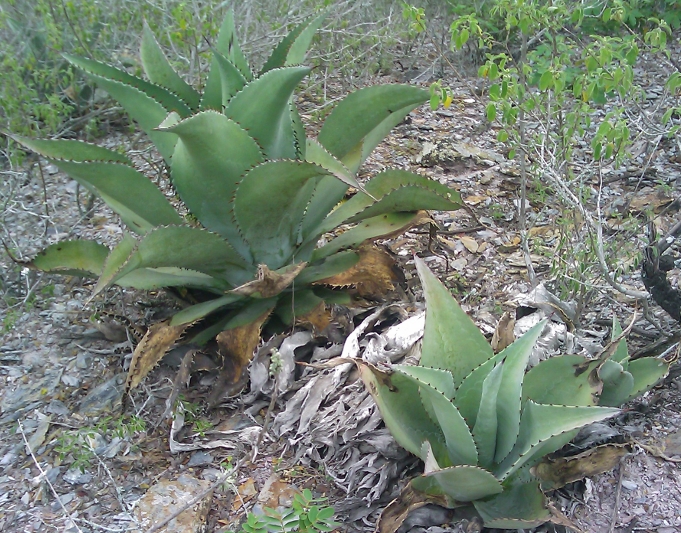
Agave cocui is a monocarpic succulent native to the arid and semi-arid zones of Venezuela and northern Colombia. It forms a dense acaulescent rosette of grayish-green lanceolate leaves reaching up to 250 cm in diameter. It is the raw material of cocuy, Venezuela's artisanal spirit distilled from the fermented heart of the plant — the Venezuelan equivalent of mezcal. It grows in tropical dry forests and xerophilous scrublands, from sea level to 1,700 m elevation.
chevron_right edit_note Proposed edits auto-approved at +3 net votes
No pending proposals for this section.
Overview
| Category | Classification |
|---|---|
| Family | Asparagaceae |
| Genus | Agave |
| Growth Habit | Acaulescent rosette, monocarpic; produces basal offsets for vegetative propagation |
| Conservation Status | Least Concern (LC) — IUCN; populations under pressure from intensive harvesting for cocuy production |
| pH Target | 6.0–8.0 |
| Type | Clay-sandy, lithosol, well-drained stony soils |
Origin & Habitat
Morphology
Lanceolate leaves 100–120 cm long and 20–30 cm wide at the base, grayish-green, rigid, with toothed margins bearing curved brown teeth and a dark terminal spine 3–5 cm long.
ecoBranched panicle inflorescence 6–8 m tall; tubular yellowish-green flowers grouped in dense umbels. Blooms only once after 15–25 years, after which the mother rosette dies.
ecoShort subterranean stem (rhizome) from which the rosette leaves and lateral offsets emerge. The heart (piña) accumulates carbohydrates used in cocuy production.
ecoExtensive fibrous root system adapted to rocky, nutrient-poor soils; shallow roots efficiently capture water from sporadic rainfall.
ecochevron_right edit_note Proposed edits auto-approved at +3 net votes
No pending proposals for this section.
Requirements
Soil & Substrate
Type
Clay-sandy, lithosol, well-drained stony soils
groups Beneficial Associations
chevron_right edit_note Proposed edits auto-approved at +3 net votes
No pending proposals for this section.
Propagation Strategy
P
E
Every 3–4 years or when roots overflow the container
Minimal fertilization: apply half-strength cactus fertilizer once in spring
Uses & Applications
Precautions / Toxicity
Sap mildly irritating to skin and mucous membranes; terminal spines pose physical hazard. No serious systemic toxicity reported in humans.
chevron_right edit_note Proposed edits auto-approved at +3 net votes
No pending proposals for this section.
Plant Health
Root rot (Fusarium spp., Phytophthora spp.) — waterlogging promotes infection
Mealybug (Planococcus citri) — colonizes leaf bases and rosette crown
Agave snout weevil (Scyphophorus acupunctatus) — larvae bore into the heart causing rapid rosette death
chevron_right edit_note Proposed edits auto-approved at +3 net votes
No pending proposals for this section.
"Cocuy holds a protected designation of origin in Venezuela (Falcón state). The species is culturally equivalent to blue agave in Mexico: the entire local artisanal economy revolves around its harvest and distillation. Intensive piña collection before flowering compromises sexual reproduction in wild populations."
chevron_right edit_note Proposed edits auto-approved at +3 net votes
No pending proposals for this section.
Scientific Integrity
🟡 MediumVote to help validate this record
Sources
Loading…
Discussion
Disclaimer
This species record is provided for educational and informational purposes only. Jardín Roca Negra does not guarantee the accuracy or completeness of the data. Content is community-curated and may be subject to revision; it should not replace advice from a qualified botanist. This species may be toxic, invasive, or subject to legal restrictions — verify before handling or cultivating. Jardín Roca Negra accepts no liability for any harm arising from reliance on this information. Images are reproduced under Creative Commons or equivalent free licenses; credits are noted below each image.