
Agave crassispina Trel.
Thick-spined Agave
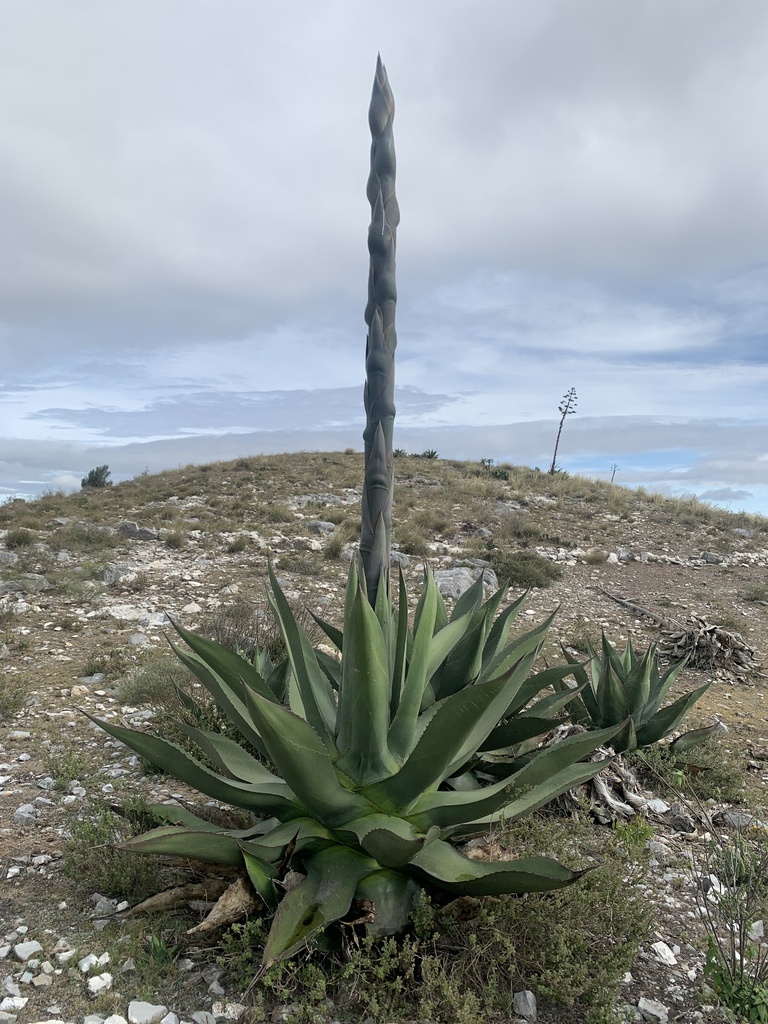
Agave crassispina (frequent synonym: Agave salmiana subsp. crassispina) is a large agave native to the semi-arid plateau of Durango and Zacatecas, Mexico. Its name refers to the exceptionally thick and robust terminal spine on its leaves. It forms imposing rosettes and is closely related to the A. salmiana complex, one of the most economically important agave groups in Mexico. It has historically been used for pulque and aguamiel production.
chevron_right edit_note Proposed edits auto-approved at +3 net votes
No pending proposals for this section.
Overview
| Category | Classification |
|---|---|
| Family | Asparagaceae |
| Genus | Agave |
| Growth Habit | Large, open rosette; slow-growing, monocarpic |
| Conservation Status | Not independently evaluated by IUCN; considered a subspecies of A. salmiana (Least Concern) |
| pH Target | 6.5–8.5 |
| Type | Clay loam to sandy loam plateau soils; tolerates soils with some calcium |
Origin & Habitat
Morphology
Lanceolate to oblanceolate leaves 70–120 cm long and 12–18 cm wide, grey-green to glaucous-green, with large curved marginal teeth. Exceptionally thick, conical dark brown-black terminal spine 5–8 cm long.
ecoGreenish-yellow to yellow flowers in dense panicles atop a 6–9 m stalk. Massive nectar production attractive to bats and nectarivorous birds.
ecoRobust stem, often visible and thickened with age; can reach 30–50 cm in length before flowering.
ecoExtensive, shallow fibrous roots covering large areas to capture seasonal rainfall.
ecochevron_right edit_note Proposed edits auto-approved at +3 net votes
No pending proposals for this section.
Requirements
Soil & Substrate
Type
Clay loam to sandy loam plateau soils; tolerates soils with some calcium
groups Beneficial Associations
chevron_right edit_note Proposed edits auto-approved at +3 net votes
No pending proposals for this section.
Propagation Strategy
R
E
Every 3–4 years when grown in large containers; preferable in permanent ground.
Low-nitrogen fertilizer (5-10-10) once at the start of spring and optionally in July. No fertilization in autumn-winter.
Uses & Applications
Precautions / Toxicity
Saponins in sap can cause contact dermatitis. Terminal spine is especially thick and hazardous.
chevron_right edit_note Proposed edits auto-approved at +3 net votes
No pending proposals for this section.
Plant Health
Root rot (Phytophthora / Fusarium) from overwatering in summer
Mealybugs (Pseudococcus spp.) between leaf bases
Agave snout weevil (Scyphophorus acupunctatus) – principal pest; larvae destroy the stem
chevron_right edit_note Proposed edits auto-approved at +3 net votes
No pending proposals for this section.
"The taxonomic position of A. crassispina is debated: treated as an independent species by Trelease but often regarded today as a subspecies of A. salmiana by other authors (Gentry, García-Mendoza). Its exceptionally thick spines distinguish it morphologically. An important ethnobotanical resource of the Zacatecas-Durango plateau."
chevron_right edit_note Proposed edits auto-approved at +3 net votes
No pending proposals for this section.
Scientific Integrity
🟡 MediumVote to help validate this record
Sources
Loading…
Discussion
Disclaimer
This species record is provided for educational and informational purposes only. Jardín Roca Negra does not guarantee the accuracy or completeness of the data. Content is community-curated and may be subject to revision; it should not replace advice from a qualified botanist. This species may be toxic, invasive, or subject to legal restrictions — verify before handling or cultivating. Jardín Roca Negra accepts no liability for any harm arising from reliance on this information. Images are reproduced under Creative Commons or equivalent free licenses; credits are noted below each image.