
Agave chihuahuana Trel.
Chihuahuan Agave
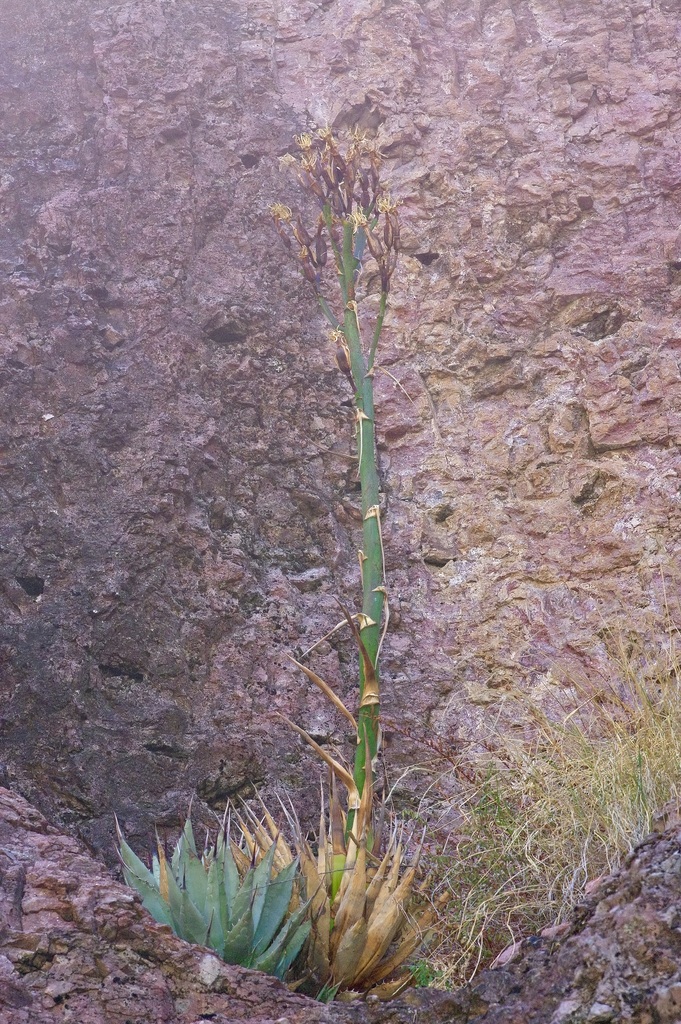
Agave chihuahuana is a monocarpic succulent native to the Chihuahuan Desert, distributed across the states of Chihuahua and Durango in Mexico. It forms medium-sized rosettes of rigid grey-green leaves with strong marginal teeth and a prominent terminal spine. Like all agaves, it blooms only once at the end of its life cycle, producing a tall flowering stalk, then dies. It is well adapted to the arid and semi-arid conditions of rocky slopes and high plateaus in northern Mexico.
chevron_right edit_note Proposed edits auto-approved at +3 net votes
No pending proposals for this section.
Overview
| Category | Classification |
|---|---|
| Family | Asparagaceae |
| Genus | Agave |
| Growth Habit | Acaulescent or very short-stemmed rosette; slow-growing, monocarpic |
| Conservation Status | Least Concern (LC) – IUCN; endemic to northern Mexico |
| pH Target | 6.5–8.0 |
| Type | Sandy-gravelly soil, nutrient-poor, with excellent drainage |
Origin & Habitat
Morphology
Linear-lanceolate leaves 40–70 cm long and 6–10 cm wide at the base, rigid, grey-green, with irregular horny marginal teeth and a dark terminal spine 3–5 cm long.
ecoTubular yellow-greenish flowers arranged in panicles atop a 4–6 m tall flowering stalk. Produced only once at the end of the plant's life cycle.
ecoVery short stem, nearly subterranean in young plants, elongating noticeably only when producing the flowering stalk at maturity.
ecoWide, shallow root system with fleshy roots enabling rapid absorption of scarce and intermittent rainfall.
ecochevron_right edit_note Proposed edits auto-approved at +3 net votes
No pending proposals for this section.
Requirements
Soil & Substrate
Type
Sandy-gravelly soil, nutrient-poor, with excellent drainage
groups Beneficial Associations
chevron_right edit_note Proposed edits auto-approved at +3 net votes
No pending proposals for this section.
Propagation Strategy
E
W
Every 3–4 years or when roots fill the container.
Low-nitrogen fertilizer (5-10-10 type) once in spring and once in early summer. No fertilizing in autumn or winter.
Uses & Applications
Precautions / Toxicity
Saponins in the sap may cause skin and gastrointestinal irritation. The terminal spine is physically hazardous.
chevron_right edit_note Proposed edits auto-approved at +3 net votes
No pending proposals for this section.
Plant Health
Root rot (Fusarium spp.) from overwatering
Mealybugs (Pseudococcus spp.) at leaf bases
Agave snout weevil (Scyphophorus acupunctatus) – principal lethal pest
chevron_right edit_note Proposed edits auto-approved at +3 net votes
No pending proposals for this section.
"A. chihuahuana is relatively poorly documented in cultivation. It is occasionally confused with A. asperrima (with which it co-occurs) and with A. lechuguilla in juvenile populations. Distinguished by its medium size and the grey-blue coloration of its leaves."
chevron_right edit_note Proposed edits auto-approved at +3 net votes
No pending proposals for this section.
Scientific Integrity
🟡 MediumVote to help validate this record
Sources
Loading…
Discussion
Disclaimer
This species record is provided for educational and informational purposes only. Jardín Roca Negra does not guarantee the accuracy or completeness of the data. Content is community-curated and may be subject to revision; it should not replace advice from a qualified botanist. This species may be toxic, invasive, or subject to legal restrictions — verify before handling or cultivating. Jardín Roca Negra accepts no liability for any harm arising from reliance on this information. Images are reproduced under Creative Commons or equivalent free licenses; credits are noted below each image.