
Agave complicata Trel. ex Ochot.
Complex Agave
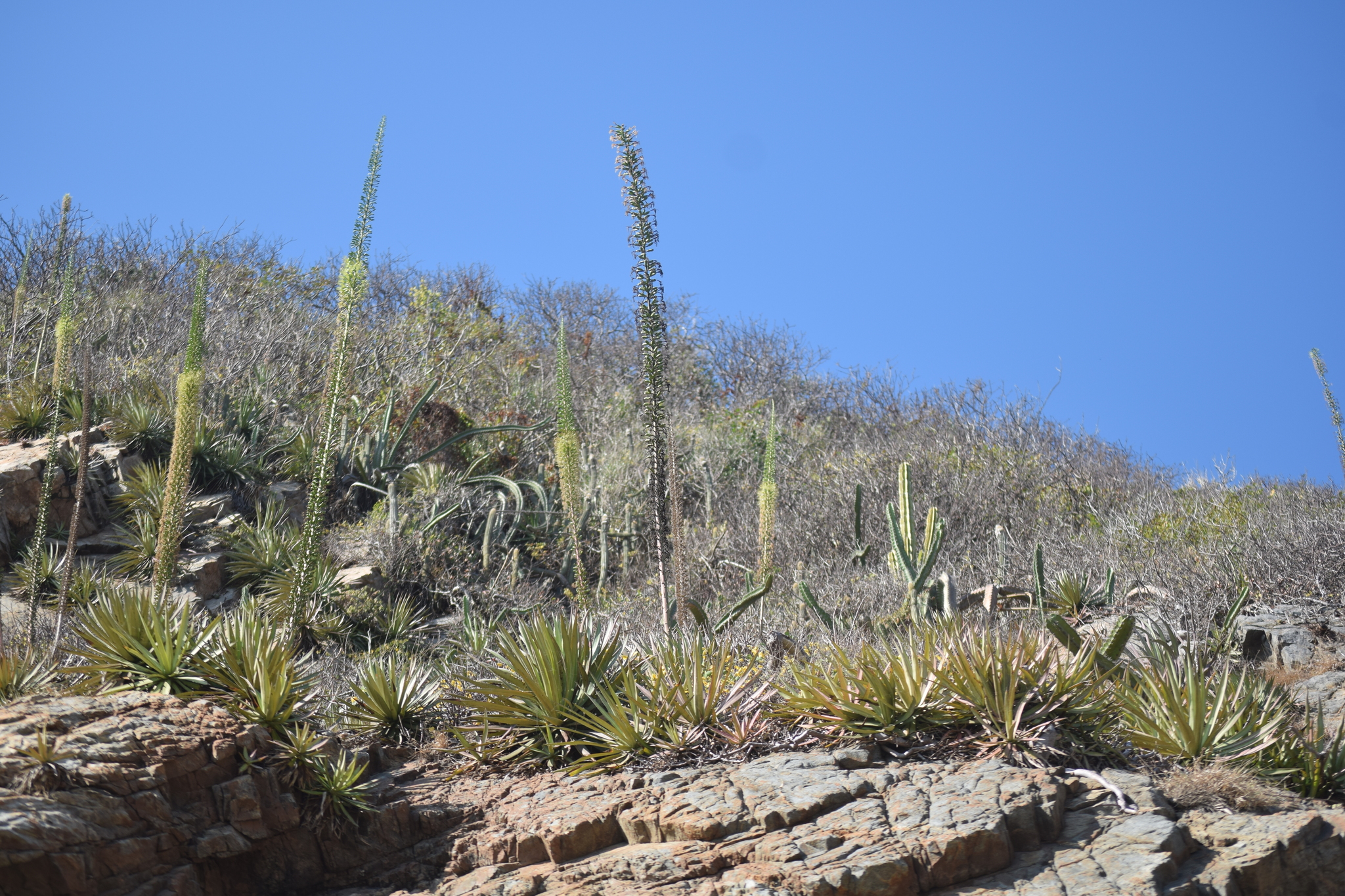
Agave complicata is one of the most important pulque agaves of the Central Mexican Highlands, distributed mainly in the states of Hidalgo, Puebla, Querétaro and San Luis Potosí between 1,600 and 2,400 m elevation. Its name 'complicata' alludes to the morphological complexity of its leaves, which display an unusual combination of intricate denticulation and flexuous blade. This species has been exploited for centuries by Otomí, Nahua and mestizo communities both for pulque production — extracting aguamiel from the heart before flowering — and for fibre (ixtle) used to manufacture sacks, nets and ropes. Its Least Concern status reflects its relative abundance in agricultural zones where it often grows semi-cultivated as living fencing.
chevron_right edit_note Proposed edits auto-approved at +3 net votes
No pending proposals for this section.
Overview
| Category | Classification |
|---|---|
| Family | Asparagaceae |
| Genus | Agave |
| Growth Habit | Large acaulescent to subcaulescent rosette, monocarpic; scarce offset production; mainly seed-propagated under wild conditions. |
| Conservation Status | Least Concern (IUCN LC). Widely distributed in the highlands; frequent in semi-cultivated settings as fences and agricultural field borders. |
| pH Target | 6.5–8.0 |
| Type | Highland volcanic and calcareous soils; tolerant of poor and rocky soils |
Origin & Habitat
Morphology
Lanceolate to linear-lanceolate, 80–130 cm long × 8–13 cm wide; grey-green to glaucous-green; blade frequently undulate or slightly twisted ('complicata' character); margins with complex, irregular horny teeth 4–8 mm, sometimes deflexed; terminal spine 4–6 cm, channelled, dark brown.
ecoTubular to urceolate, 7–9 cm, yellow-green; gathered in a spicate panicle on a scape 5–8 m tall; summer flowering (July–September); the aguamiel produced before flowering reaches 3–6 litres per day.
ecoVery voluminous conical to globose piña, 30–50 cm in diameter; constitutes the reservoir of sugars and water that is fermented into pulque or directed to artisanal distillates in some areas.
ecoDeep and extensive root system, with storage fleshy roots up to 1.5 m and a dense network of shallow fibrous roots; allows survival on the highland with winter frosts and summer droughts.
ecochevron_right edit_note Proposed edits auto-approved at +3 net votes
No pending proposals for this section.
Requirements
Soil & Substrate
Type
Highland volcanic and calcareous soils; tolerant of poor and rocky soils
groups Beneficial Associations
chevron_right edit_note Proposed edits auto-approved at +3 net votes
No pending proposals for this section.
Propagation Strategy
R
N
Transplant to final soil when possible; in pots every 2–3 years until adult size.
Moderate spring fertilisation: mature compost incorporated into substrate (10% vol.) + natural phosphate. No synthetic nitrogen fertilisers on adult plants.
Uses & Applications
Precautions / Toxicity
Low toxicity. Sap may cause mild skin irritation in sensitive individuals. The terminal spine is the main mechanical hazard. Not toxic to mammals in normal amounts.
chevron_right edit_note Proposed edits auto-approved at +3 net votes
No pending proposals for this section.
Plant Health
Heart rot (Erwinia, Fusarium) — main risk in cultivation with frequent watering; drain well and space irrigation in autumn-winter.
Agave mealybug (Pseudococcus spp.) — inspectable at leaf base; treat with neem oil or imidacloprid.
Agave snout weevil (Scyphophorus acupunctatus) — recurring pest on the highlands; early detection (sawdust at base) allows timely intervention.
chevron_right edit_note Proposed edits auto-approved at +3 net votes
No pending proposals for this section.
"One of the most culturally important agaves in central Mexico; its semi-controlled cultivation as living fencing has ensured the conservation of numerous populations. In garden collections it is one of the most frost-resistant agaves available for continental climates."
chevron_right edit_note Proposed edits auto-approved at +3 net votes
No pending proposals for this section.
Scientific Integrity
🟡 MediumVote to help validate this record
Sources
Loading…
Discussion
Disclaimer
This species record is provided for educational and informational purposes only. Jardín Roca Negra does not guarantee the accuracy or completeness of the data. Content is community-curated and may be subject to revision; it should not replace advice from a qualified botanist. This species may be toxic, invasive, or subject to legal restrictions — verify before handling or cultivating. Jardín Roca Negra accepts no liability for any harm arising from reliance on this information. Images are reproduced under Creative Commons or equivalent free licenses; credits are noted below each image.