
Agave colimana Gentry
Colima Agave
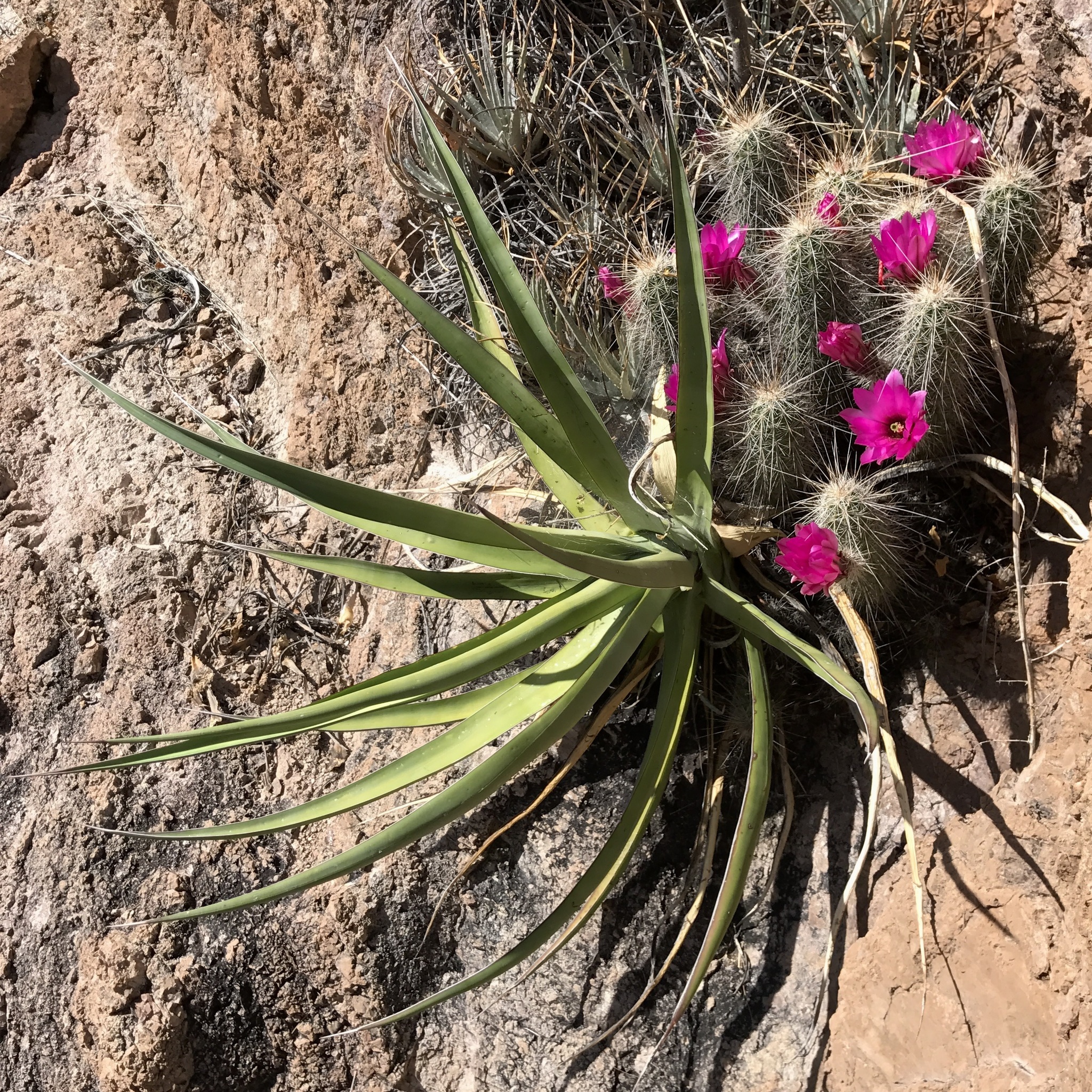
Agave colimana was described by Howard Scott Gentry in his 1982 monograph as a species endemic to the Pacific slope of Mexico, restricted mainly to the states of Colima and Jalisco between 200 and 1,400 m elevation. It forms robust rosettes of dark grey-green leaves, broader at the base, with pronounced marginal teeth and a long, powerful terminal spine. It is one of the agaves used in artisanal mezcal production in the Colima region, where it is locally known as 'maguey de Colima' or 'maguey verde'. Its flowering, which occurs after 15–25 years, generates a massive scape of up to 7 m laden with yellow flowers exploited by local pollinators including bats and bees.
chevron_right edit_note Proposed edits auto-approved at +3 net votes
No pending proposals for this section.
Overview
| Category | Classification |
|---|---|
| Family | Asparagaceae |
| Genus | Agave |
| Growth Habit | Robust large acaulescent to subcaulescent rosette, monocarpic; moderate basal offset production. |
| Conservation Status | Not Evaluated (IUCN). Distribution limited to Colima and Jalisco; agricultural expansion and extraction for mezcal put continuous pressure on wild populations. |
| pH Target | 6.0–7.5 |
| Type | Clay-loam to sandy-loam, well-drained soils; tolerates some fertility |
Origin & Habitat
Morphology
Ovate to lanceolate, 70–110 cm long × 12–18 cm wide at base; grey-green to dark green; adaxial surface flat to concave; margins with strong horny teeth 5–10 mm separated 1.5–3 cm; terminal spine 4–7 cm, channelled, dark brown to black.
ecoTubular, 7–9 cm long, yellow; clustered in a spicate panicle on a scape 5–7 m tall; late spring to summer flowering (May–July); nectar attracts bats, hummingbirds and bees.
ecoShort and very thick (subcaulescent), 10–25 cm tall and 20–35 cm in diameter; densely covered with leaf scars; the central 'piña' is the organ harvested for mezcal.
ecoThickened fleshy roots (some with water-storage function) and fibrous; mixed deep (up to 1 m) and shallow spreading system to capture seasonal rainfall.
ecochevron_right edit_note Proposed edits auto-approved at +3 net votes
No pending proposals for this section.
Requirements
Soil & Substrate
Type
Clay-loam to sandy-loam, well-drained soils; tolerates some fertility
groups Beneficial Associations
chevron_right edit_note Proposed edits auto-approved at +3 net votes
No pending proposals for this section.
Propagation Strategy
P
T
Every 3–4 years; the rosette grows quickly and requires large containers.
Moderate fertilisation in spring-summer: NPK 10-5-10 once a month during the active growing season.
Uses & Applications
Precautions / Toxicity
Leaf sap moderately irritant to skin and mucous membranes; terminal spine can cause septic wounds. Handle with heavy gloves.
chevron_right edit_note Proposed edits auto-approved at +3 net votes
No pending proposals for this section.
Plant Health
Piña rot (Fusarium oxysporum, Erwinia spp.) — destroys the heart; drain well and avoid base wounds.
Mealybugs (Pseudococcus spp.) — proliferates under stress conditions; treat with neem oil or systemic insecticide.
Agave snout weevil (Scyphophorus acupunctatus) — principal pest in Colima and Jalisco; preventive monitoring is essential in summer.
chevron_right edit_note Proposed edits auto-approved at +3 net votes
No pending proposals for this section.
"Species of great regional ethnobotanical value; wild populations have declined in some areas of Colima due to mezcal extraction. Preferring vegetatively propagated material from certified nurseries is recommended."
chevron_right edit_note Proposed edits auto-approved at +3 net votes
No pending proposals for this section.
Scientific Integrity
🟡 MediumVote to help validate this record
Sources
Loading…
Discussion
Disclaimer
This species record is provided for educational and informational purposes only. Jardín Roca Negra does not guarantee the accuracy or completeness of the data. Content is community-curated and may be subject to revision; it should not replace advice from a qualified botanist. This species may be toxic, invasive, or subject to legal restrictions — verify before handling or cultivating. Jardín Roca Negra accepts no liability for any harm arising from reliance on this information. Images are reproduced under Creative Commons or equivalent free licenses; credits are noted below each image.