
Agave chrysoglossa I.M.Johnst.
Golden-tongue Agave
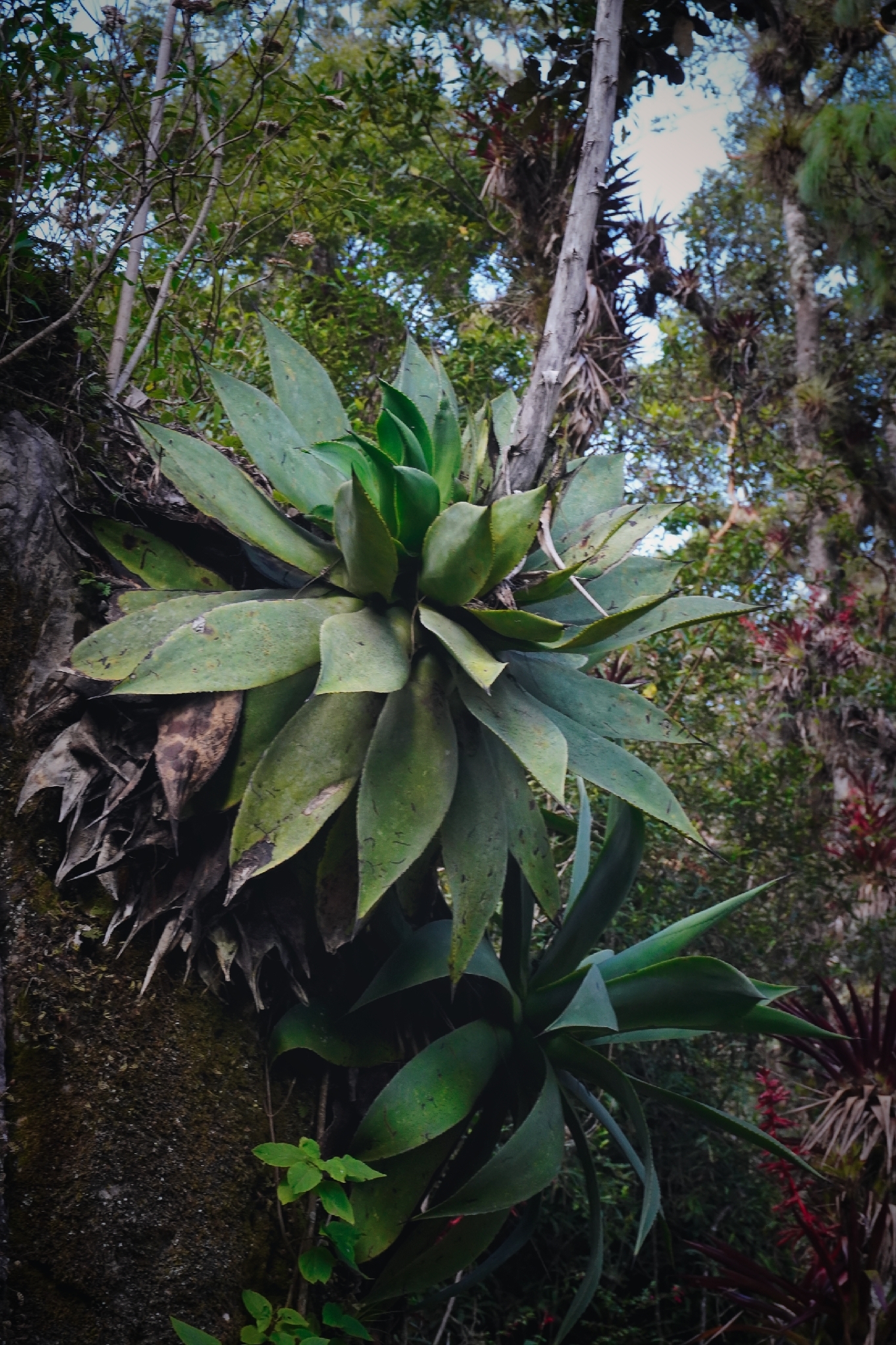
Agave chrysoglossa is one of the most distinctive agaves of the Sonoran Desert, owing to the prominent yellow to golden midstripe running along the upper face of its narrow leaves — the feature that gives it its name ('chrysoglossa' = golden tongue). It grows on rocky slopes, dry arroyos and canyon bottoms from sea level to about 1,000 m in Sonora, Sinaloa and southern Baja California. Its relatively compact rosettes, 40–70 cm in diameter, frequently form colonies through prolific basal offset production, making it one of the few agaves that can be maintained in collections from vegetative progeny. The species was described by Ivan Murray Johnston in 1924 from specimens collected in Sonora.
chevron_right edit_note Proposed edits auto-approved at +3 net votes
No pending proposals for this section.
Overview
| Category | Classification |
|---|---|
| Family | Asparagaceae |
| Genus | Agave |
| Growth Habit | Small to medium acaulescent rosette, monocarpic; prolific in basal offset production. |
| Conservation Status | Least Concern (IUCN LC). Widely distributed across the Sonoran Desert; no immediate threats, although overgrazing can affect local populations. |
| pH Target | 6.5–8.0 |
| Type | Sandy and rocky, ultra-mineral soils, very low organic content |
Origin & Habitat
Morphology
Linear to linear-lanceolate, 30–55 cm long × 1.5–3 cm wide; rigid, ascending; dark green with a prominent yellow to golden midstripe; margins with small horny teeth 2–4 mm; terminal spine 2.5–4 cm, grooved, light brown to grey.
ecoTubular, 4.5–6 cm long, bright yellow; clustered in dense spikes on a scape 3–4.5 m tall; summer to autumn flowering (July–October); pollinated mainly by nectarivorous bats.
ecoVery shortly caulescent (practically acaulescent), 3–8 cm; with leaf scar marks and thickened base that concentrates water and nutrient reserves.
ecoShallow and spreading fibrous roots, adapted to thin and rocky desert soils. Capable of rapidly absorbing water from sporadic rains.
ecochevron_right edit_note Proposed edits auto-approved at +3 net votes
No pending proposals for this section.
Requirements
Soil & Substrate
Type
Sandy and rocky, ultra-mineral soils, very low organic content
groups Beneficial Associations
chevron_right edit_note Proposed edits auto-approved at +3 net votes
No pending proposals for this section.
Propagation Strategy
U
O
Every 4–5 years; this species prefers slightly constricted roots.
A single annual application in spring with very diluted mineral fertiliser (NPK 5-10-10). Avoid nitrogen-heavy fertilisation.
Uses & Applications
Precautions / Toxicity
Mildly irritant. Sap may cause dermatitis in sensitive skin. The terminal spine can produce deep wounds; handle with heavy gloves.
chevron_right edit_note Proposed edits auto-approved at +3 net votes
No pending proposals for this section.
Plant Health
Root rot (Phytophthora spp., Pythium spp.) — maximum risk in collections; 100% mineral substrate and minimal watering are essential.
Mealybugs (Pseudococcus spp.) — attack roots and leaf base under water stress; treat with systemic insecticide.
Agave snout weevil (Scyphophorus acupunctatus) — main threat; larvae destroy the heart; apply preventive imidacloprid in summer.
chevron_right edit_note Proposed edits auto-approved at +3 net votes
No pending proposals for this section.
"The golden midstripe is a diagnostic taxonomic character but also variable; specimens from shaded areas may show it more faintly. To maximise colour and rosette compactness, grow under full sun exposure."
chevron_right edit_note Proposed edits auto-approved at +3 net votes
No pending proposals for this section.
Scientific Integrity
🟡 MediumVote to help validate this record
Sources
Loading…
Discussion
Disclaimer
This species record is provided for educational and informational purposes only. Jardín Roca Negra does not guarantee the accuracy or completeness of the data. Content is community-curated and may be subject to revision; it should not replace advice from a qualified botanist. This species may be toxic, invasive, or subject to legal restrictions — verify before handling or cultivating. Jardín Roca Negra accepts no liability for any harm arising from reliance on this information. Images are reproduced under Creative Commons or equivalent free licenses; credits are noted below each image.