
Agave angustiarum Trel.
Rabo de León Agave
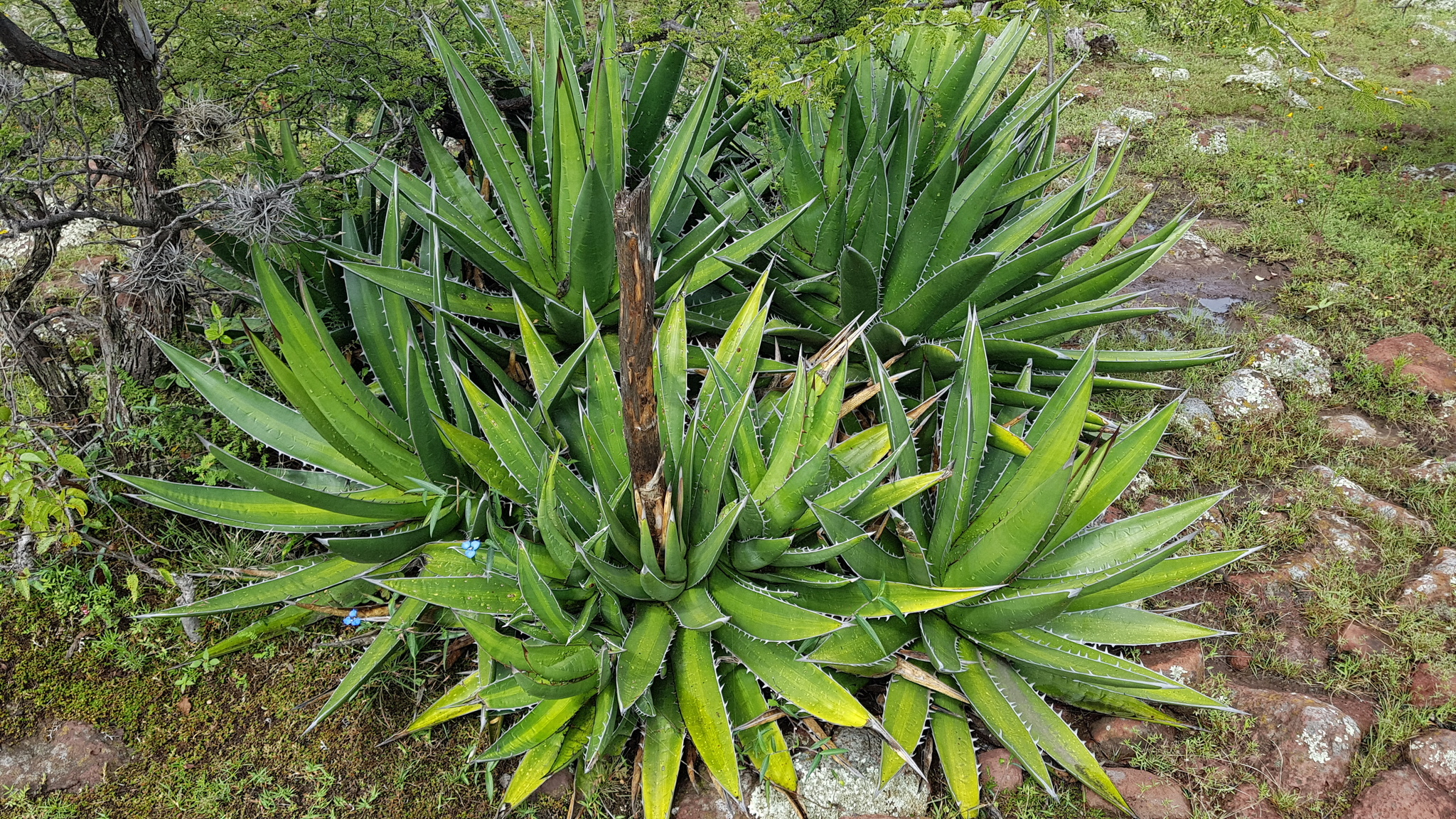
Agave angustiarum is a monocarpic, succulent perennial agave endemic to central and southern Mexico. It forms a compact rosette of narrow, lanceolate leaves that range from bright green to blue-green, with fine marginal teeth and a stiff terminal spine. Its common name 'rabo de león' (lion's tail) alludes to the graceful arching shape of its mature leaves. It grows in xeric scrublands and tropical dry forests between 600 and 1,500 m elevation, withstanding prolonged droughts through highly succulent tissues. Toward the end of its life (10–25 years) it sends up a striking flower spike up to 3 m tall bearing greenish-yellow flowers arranged in panicles; the main rosette dies after flowering, leaving basal offsets.
chevron_right edit_note Proposed edits auto-approved at +3 net votes
No pending proposals for this section.
Overview
| Category | Classification |
|---|---|
| Family | Asparagaceae |
| Genus | Agave |
| Growth Habit | Compact basal rosette; slow-growing; monocarpic; produces lateral offsets. |
| Conservation Status | Least Concern (IUCN, 2020). Broad distribution across several Mexican states with multiple stable subpopulations. Locally threatened by habitat conversion and artisanal extraction. |
| pH Target | 6.0–8.0 |
| Type | Sandy to stony, very well-drained, nutrient-poor soil |
Origin & Habitat
Morphology
Lanceolate to linear, erect or slightly arching, 30–60 cm long and 4–5.5 cm wide at the base. Stiff and fleshy in texture; bright green to blue-green in color. Margin with small, irregularly spaced corneous teeth; terminal spine 2–3 cm long, dark brown to black.
ecoTubular, greenish-yellow flowers, 5–7 cm long, arranged in dense panicles atop a floral stalk (quiote) 2.5–3 m tall. Each flower has 6 tepals, 6 exserted stamens, and a trilocular pistil. Flowering occurs in summer, from May to August.
ecoBasal stem very short, almost acaulescent, from which leaves emerge in a tight spiral arrangement. The only elongated stem visible is the woody floral scape (quiote) that appears at the end of the plant's life cycle, reaching up to 3 m in height.
ecoFibrous and shallow root system that extends laterally up to twice the rosette diameter to maximize rainwater capture. Main roots are somewhat thickened and fleshy, acting as water and nutrient reserves during the dry season.
ecochevron_right edit_note Proposed edits auto-approved at +3 net votes
No pending proposals for this section.
Requirements
Soil & Substrate
Type
Sandy to stony, very well-drained, nutrient-poor soil
groups Beneficial Associations
chevron_right edit_note Proposed edits auto-approved at +3 net votes
No pending proposals for this section.
Propagation Strategy
P
O
Every 3–5 years or when roots overflow the container. Spring is the best time to repot.
Minimal fertilization: one application of low-nitrogen fertilizer (NPK 5-10-10) at the start of spring. Excess nitrogen produces soft leaves prone to disease.
Uses & Applications
Precautions / Toxicity
Mildly toxic. Fresh sap may cause skin irritation and contact dermatitis in sensitive individuals. Calcium oxalates present in the leaves are irritating to mucous membranes if ingested raw. Not considered severely toxic to humans or pets under normal exposure.
chevron_right edit_note Proposed edits auto-approved at +3 net votes
No pending proposals for this section.
Plant Health
chevron_right edit_note Proposed edits auto-approved at +3 net votes
No pending proposals for this section.
"Agave angustiarum belongs to section Crenatae and is closely related to A. ghiesbreghtii and A. huehueteca. Artisanal mezcal uses have been documented in communities of the Tehuacán-Cuicatlán Valley (Puebla/Oaxaca), although not at the commercial scale of A. angustifolia. The species tolerates both calcareous and volcanic substrates."
chevron_right edit_note Proposed edits auto-approved at +3 net votes
No pending proposals for this section.
Scientific Integrity
🟡 MediumVote to help validate this record
Sources
Loading…
Discussion
Disclaimer
This species record is provided for educational and informational purposes only. Jardín Roca Negra does not guarantee the accuracy or completeness of the data. Content is community-curated and may be subject to revision; it should not replace advice from a qualified botanist. This species may be toxic, invasive, or subject to legal restrictions — verify before handling or cultivating. Jardín Roca Negra accepts no liability for any harm arising from reliance on this information. Images are reproduced under Creative Commons or equivalent free licenses; credits are noted below each image.