
Agave aurea Brandegee
Golden agave
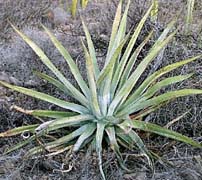
Agave aurea is a monocarpic succulent endemic to the Baja California Peninsula, where it inhabits coastal and interior scrublands on rocky and sandy soils. Its name 'aurea' (Latin for golden) refers to its striking yellow-gold flowers borne on a panicle 4–7 m tall. The mature rosette is large and imposing, with broad gray-green to blue-green leaves reaching up to 1.5 m in total diameter. Like all agaves, it is monocarpic: it flowers only once at the end of its life — typically after 15–30 years — and dies after setting seed, occasionally leaving a few basal offsets.
chevron_right edit_note Proposed edits auto-approved at +3 net votes
No pending proposals for this section.
Overview
| Category | Classification |
|---|---|
| Family | Asparagaceae |
| Genus | Agave |
| Growth Habit | Large acaulescent rosette, solitary or with few basal offsets; seasonally active growth in summer |
| Conservation Status | Data Deficient (DD) — IUCN; endemic to the Baja California Peninsula, with reduced populations |
| pH Target | 6.5–8.0 |
| Type | Sandy or very well-drained mineral soil; tolerates some coastal salinity |
Origin & Habitat
Morphology
Oblanceolate to broadly lanceolate leaves, 60–100 cm long and 10–18 cm wide at mid-blade, gray-green to blue-green. Margins bear stout brownish corneous teeth spaced 1–2 cm apart; the terminal spine is dark, conic, 4–7 cm long.
ecoInflorescence a panicle 4–7 m tall with numerous umbels of yellow-gold tubular flowers 6–9 cm long. Flowers produce abundant nectar and are pollinated by Leptonycteris bats. Flowering occurs in summer.
ecoStem very short or acaulescent, barely visible in young specimens. With age may develop a short, stout caudex. The floral scape is erect, solid, and very thick at the base.
ecoFibrous and extensive root system adapted to the sandy and rocky soils of the Baja California Peninsula. Shallow roots capture moisture from coastal fog (camanchaca) in addition to seasonal rainfall.
ecochevron_right edit_note Proposed edits auto-approved at +3 net votes
No pending proposals for this section.
Requirements
Soil & Substrate
Type
Sandy or very well-drained mineral soil; tolerates some coastal salinity
groups Beneficial Associations
chevron_right edit_note Proposed edits auto-approved at +3 net votes
No pending proposals for this section.
Propagation Strategy
Prefer propagation from fresh seeds in fine sand substrate with bottom heat (25–30 °C)
Overwatering, especially in winter
Every 3–5 years; preferably in spring before the start of active growth
One application of balanced low-nitrogen fertilizer (5-10-10) in spring. Avoid in autumn and winter.
Uses & Applications
Precautions / Toxicity
Leaves contain calcium oxalate and saponins; sap may cause dermatitis in sensitive skin. Terminal spines are dangerous — handle with leather gloves.
chevron_right edit_note Proposed edits auto-approved at +3 net votes
No pending proposals for this section.
Plant Health
Root rot (Phytophthora spp.) from overwatering or poor drainage
Mealybugs (Pseudococcus spp.) at leaf bases
Agave snout weevil (Scyphophorus acupunctatus) — larvae destroy the central stem
chevron_right edit_note Proposed edits auto-approved at +3 net votes
No pending proposals for this section.
"Agave aurea is poorly represented in botanical collections outside Mexico. Its strict endemism to the Baja California Peninsula and coastal development pressure make it a priority species for monitoring. Natural hybrids with A. capensis have been documented in the Los Cabos area."
chevron_right edit_note Proposed edits auto-approved at +3 net votes
No pending proposals for this section.
Scientific Integrity
🟡 MediumVote to help validate this record
Sources
Loading…
Discussion
Disclaimer
This species record is provided for educational and informational purposes only. Jardín Roca Negra does not guarantee the accuracy or completeness of the data. Content is community-curated and may be subject to revision; it should not replace advice from a qualified botanist. This species may be toxic, invasive, or subject to legal restrictions — verify before handling or cultivating. Jardín Roca Negra accepts no liability for any harm arising from reliance on this information. Images are reproduced under Creative Commons or equivalent free licenses; credits are noted below each image.