
Aeonium aureum (Webb & Berthel.) A.Berger
Golden aeonium
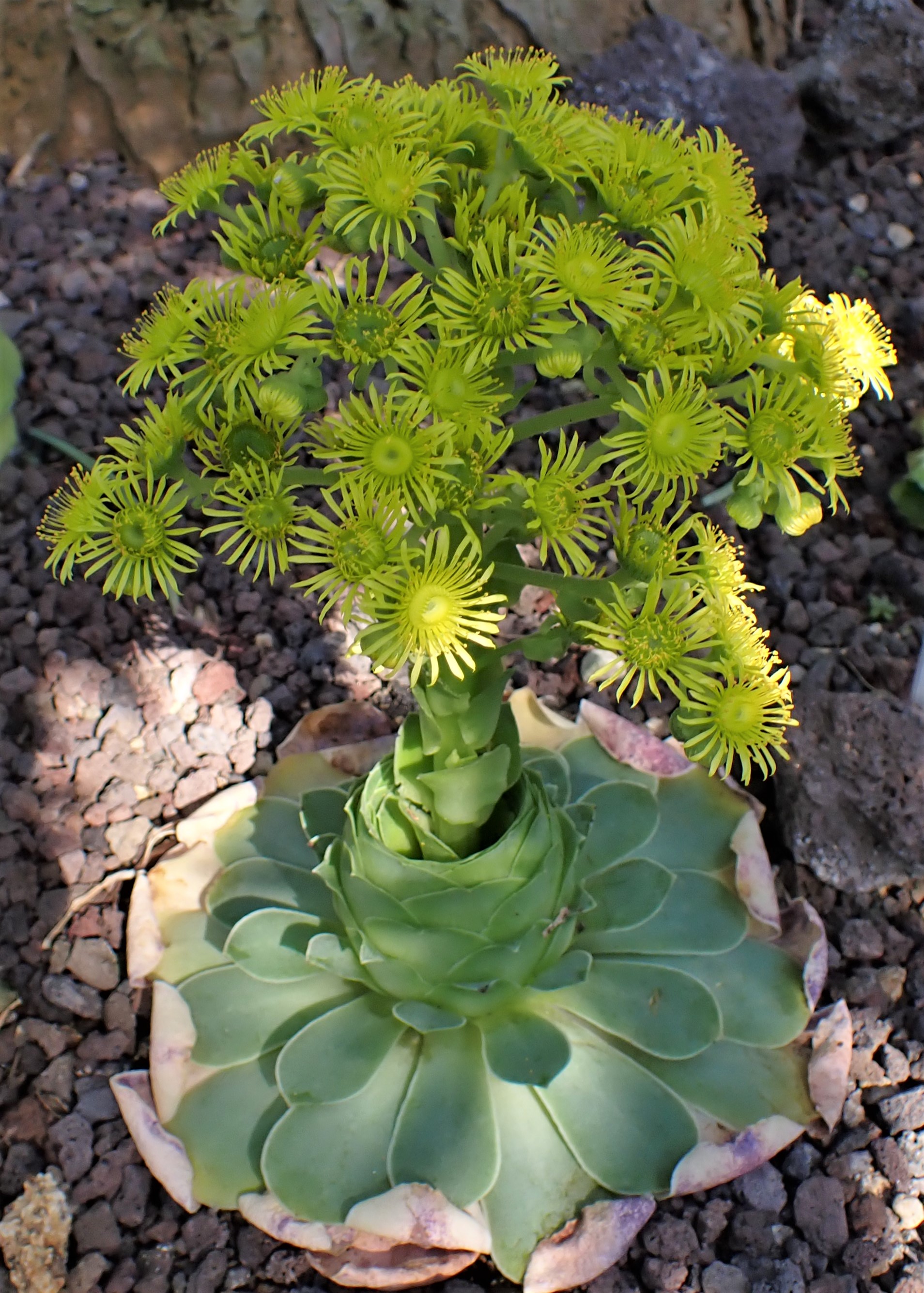
Aeonium aureum, formerly known as Greenovia aurea, is a succulent endemic to La Palma (Canary Islands) that grows in humid ravines and cliff edges between 400 and 1,600 m elevation. Its compact rosettes, deep green with a reddish margin, take on a characteristic 'closed rose' shape in summer: the leaves fold inward to form a sphere, minimising water loss during summer dormancy. As a typical Aeonium, it is a winter grower: its active period runs from autumn to spring, while it enters deep dormancy in summer. The species is monocarpic at the individual rosette level — each head flowers once and dies, but the plant persists through abundant offsets.
chevron_right edit_note Proposed edits auto-approved at +3 net votes
No pending proposals for this section.
Overview
| Category | Classification |
|---|---|
| Family | Crassulaceae |
| Genus | Aeonium |
| Growth Habit | Caespitose succulent with compact rosettes 4–8 cm in diameter; produces numerous offsets and forms dense colonies; height 10–20 cm |
| Conservation Status | Endangered (EN) — IUCN: extremely restricted range on La Palma; habitat threatened by wildfires and climate change |
| pH Target | 6.0–7.5 |
| Type | Volcanic-mineral, highly porous, low in organic matter |
Origin & Habitat
Morphology
Spatulate to oblong leaves, 2–4 cm long, bright green with a reddish ciliate margin; covered in a fine waxy layer that reduces transpiration. In summer they compress into a very distinctive closed spherical rosette.
ecoGolden yellow flowers gathered in a terminal cyme 8–12 cm wide; each flower 1–1.5 cm, with 14–24 lanceolate petals in whorls. Flowering occurs between January and April; the rosette dies thereafter.
ecoShort, basally woody stems 5–15 cm bearing prominent leaf scars. The plant produces short stolons that generate the lateral offsets responsible for vegetative persistence.
ecoFibrous, shallow root system perfectly adapted to the thin, rocky soils of Canarian cliffs. Roots are highly efficient at absorbing seasonal moisture.
ecochevron_right edit_note Proposed edits auto-approved at +3 net votes
No pending proposals for this section.
Requirements
Soil & Substrate
Type
Volcanic-mineral, highly porous, low in organic matter
groups Beneficial Associations
chevron_right edit_note Proposed edits auto-approved at +3 net votes
No pending proposals for this section.
Propagation Strategy
- 1 Wait until September-October, when the offsets have resumed active growth.
- 2 With a sterilized knife, separate the offset from the mother plant, leaving 1–2 cm of stem.
- 3 Allow the wound to callus in shade with ventilation for 48–72 hours.
- 4 Plant in dry mineral substrate (pumice + perlite) without burying the stem too deeply.
- 5 Do not water for the first 5–7 days; then water very lightly until firm roots appear (3–5 weeks).
- 6 Once rooted, move to final position with direct sunlight.
- 1 Collect ripe seeds at the end of flowering (April-May) and store dry until autumn.
- 2 Sow on the surface of moist sandy substrate without covering (seeds need light).
- 3 Maintain at 15–20 °C with bright indirect light; cover with clear film to retain moisture.
- 4 Remove film as soon as first seedlings appear; ventilate daily.
- 5 Transplant to individual pots when rosettes are 1–2 cm wide.
Use unglazed terracotta pots: they promote lateral evaporation and prevent summer rot.
Watering in summer when the rosette is closed: causes lethal crown and root rot.
Every 2–3 years, in September-October at the start of active growth
Once a year in October-November, low-nitrogen mineral fertilizer (5-10-10 or similar); do not fertilize in summer
Uses & Applications
Precautions / Toxicity
No known toxicity reported for humans or domestic animals.
chevron_right edit_note Proposed edits auto-approved at +3 net votes
No pending proposals for this section.
Plant Health
Root and crown rot (Phytophthora spp., Fusarium spp.): the greatest risk in cultivation, especially in summer when the plant is dormant. Keep substrate dry in July-September and ensure perfect drainage.
Mealybug (Planococcus citri, Pseudococcus spp.): hides between the leaves of the closed summer rosette. Inspect at the restart of growth in autumn; treat with neem oil or systemic insecticide.
Black aphid (Aphis fabae): may attack flowering stems in spring. Control with potassium soap or natural pyrethrin.
chevron_right edit_note Proposed edits auto-approved at +3 net votes
No pending proposals for this section.
"Aeonium aureum was originally described as Greenovia aurea by Webb & Berthelot in 1840 and reclassified into Aeonium by A.Berger in 1928. Recent phylogenetic studies (Mes et al., 2003) confirm that Greenovia is paraphyletic within Aeonium, justifying synonymy. The 'closed rosette' strategy in summer is a convergent adaptation also seen in other high-altitude Canarian Aeonium (A. simsii, A. nobile). The species is considered Endangered on La Palma due to the limited number of populations and the impact of the 2021 and 2023 wildfires."
chevron_right edit_note Proposed edits auto-approved at +3 net votes
No pending proposals for this section.
Scientific Integrity
🟡 MediumVote to help validate this record
Sources
Loading…
Discussion
Disclaimer
This species record is provided for educational and informational purposes only. Jardín Roca Negra does not guarantee the accuracy or completeness of the data. Content is community-curated and may be subject to revision; it should not replace advice from a qualified botanist. This species may be toxic, invasive, or subject to legal restrictions — verify before handling or cultivating. Jardín Roca Negra accepts no liability for any harm arising from reliance on this information. Images are reproduced under Creative Commons or equivalent free licenses; credits are noted below each image.