
Aeonium haworthii Salm-Dyck ex Webb & Berthel.
Pinwheel Aeonium
Aeonium haworthii, 'Haworth's Aeonium', is a branched succulent shrub endemic to the Canary Islands (especially Tenerife and La Palma), prized for its elegant rosettes of grey to grey-green leaves with striking red or pink margins. It forms compact shrubs 40–60 cm tall with multiple terminal rosettes 8–12 cm across, very decorative in Mediterranean gardens and containers. Like all aeoniums, its rosettes are monocarpic.
chevron_right edit_note Proposed edits auto-approved at +3 net votes
No pending proposals for this section.
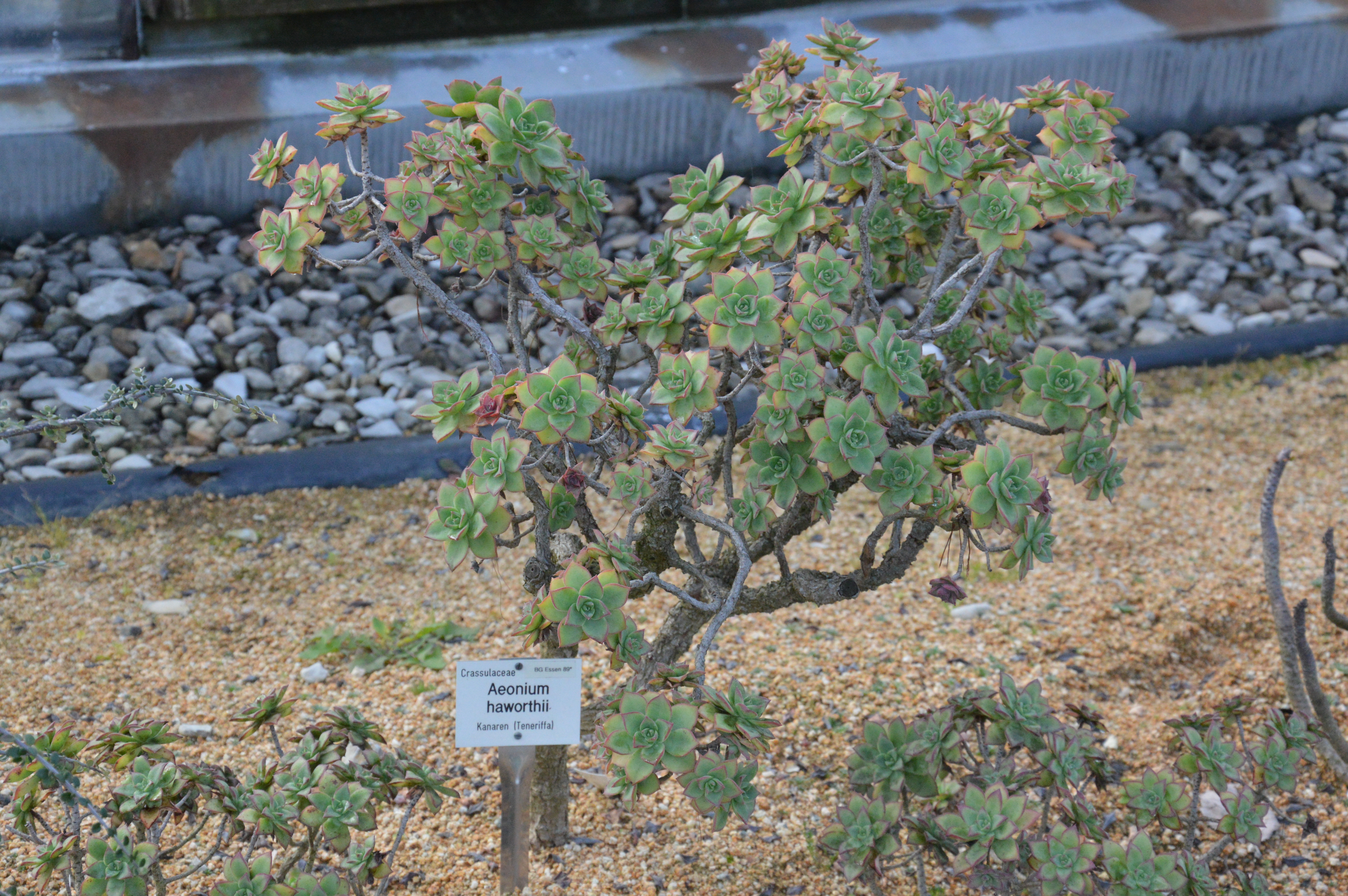
© Dean Wm. Taylor
CC BY 2.0
Overview
| Category | Classification |
|---|---|
| Family | Crassulaceae |
| Genus | Aeonium |
| Growth Habit | Compact branched subshrub 40–60 cm with numerous terminal rosettes; active growth in autumn–winter, semi-dormant in summer. |
| Conservation Status | Species not threatened. Wild in the Canary Islands and widely cultivated worldwide as a Mediterranean ornamental. |
| pH Target | 6.0 – 7.5 |
| Type | Loamy soil with good drainage; tolerates some organic matter content, unlike most succulents. |
Origin & Habitat
Morphology
Spatulate leaves 4–7 cm, grey-green or light green with well-defined red or pink margin and mucronate apex; surface slightly sticky.
ecoWhite or pale pink flowers with 10–15 petals in compact terminal corymbs; the rosette dies after flowering. Blooms in spring.
ecoGreyish woody stems that branch from the base, shorter and more branched than those of A. arboreum.
ecoFibrous root system of moderate depth; more tolerant of relatively rich soils than most succulents.
ecochevron_right edit_note Proposed edits auto-approved at +3 net votes
No pending proposals for this section.
Requirements
Soil & Substrate
Type
Loamy soil with good drainage; tolerates some organic matter content, unlike most succulents.
groups Beneficial Associations
chevron_right edit_note Proposed edits auto-approved at +3 net votes
No pending proposals for this section.
Propagation Strategy
- 1 Cut a branch with a terminal rosette 8–12 cm long in autumn or early spring.
- 2 Remove lower leaves leaving 3–4 cm of bare stem.
- 3 Let the cut dry for 2–3 days in a shaded, well-ventilated place.
- 4 Plant in slightly moist substrate; roots in 3–5 weeks.
Plant in groups to create a very decorative compact Mediterranean shrub effect.
Watering in summer at the same frequency as in winter, causing basal rots.
Every 2–3 years in autumn before the start of the growing season.
Half-strength balanced fertilizer every 4 weeks in autumn and winter; none in summer.
Uses & Applications
Precautions / Toxicity
Not toxic to humans. No significant toxicities for pets have been documented. Considered a low-risk plant.
chevron_right edit_note Proposed edits auto-approved at +3 net votes
No pending proposals for this section.
Plant Health
Mealybugs on rosettes and branching points; treat with isopropyl alcohol or systemic insecticide at the first sign.
Stem rot in summer from excess watering during the rest period; almost completely suspend watering in hot months.
Green aphid on young shoots in spring; treat with insecticidal potassium soap.
chevron_right edit_note Proposed edits auto-approved at +3 net votes
No pending proposals for this section.
"The reddish leaf margins of A. haworthii result from anthocyanin accumulation in response to light and thermal stress; this pigment acts as a protective screen against excessive UV radiation and also as a visual signal for pollinators searching for flowers from a distance."
chevron_right edit_note Proposed edits auto-approved at +3 net votes
No pending proposals for this section.
Scientific Integrity
🟡 MediumVote to help validate this record
Sources
Loading…
Discussion
Disclaimer
This species record is provided for educational and informational purposes only. Jardín Roca Negra does not guarantee the accuracy or completeness of the data. Content is community-curated and may be subject to revision; it should not replace advice from a qualified botanist. This species may be toxic, invasive, or subject to legal restrictions — verify before handling or cultivating. Jardín Roca Negra accepts no liability for any harm arising from reliance on this information. Images are reproduced under Creative Commons or equivalent free licenses; credits are noted below each image.