
Agave parryi Engelm.
Parry's agave
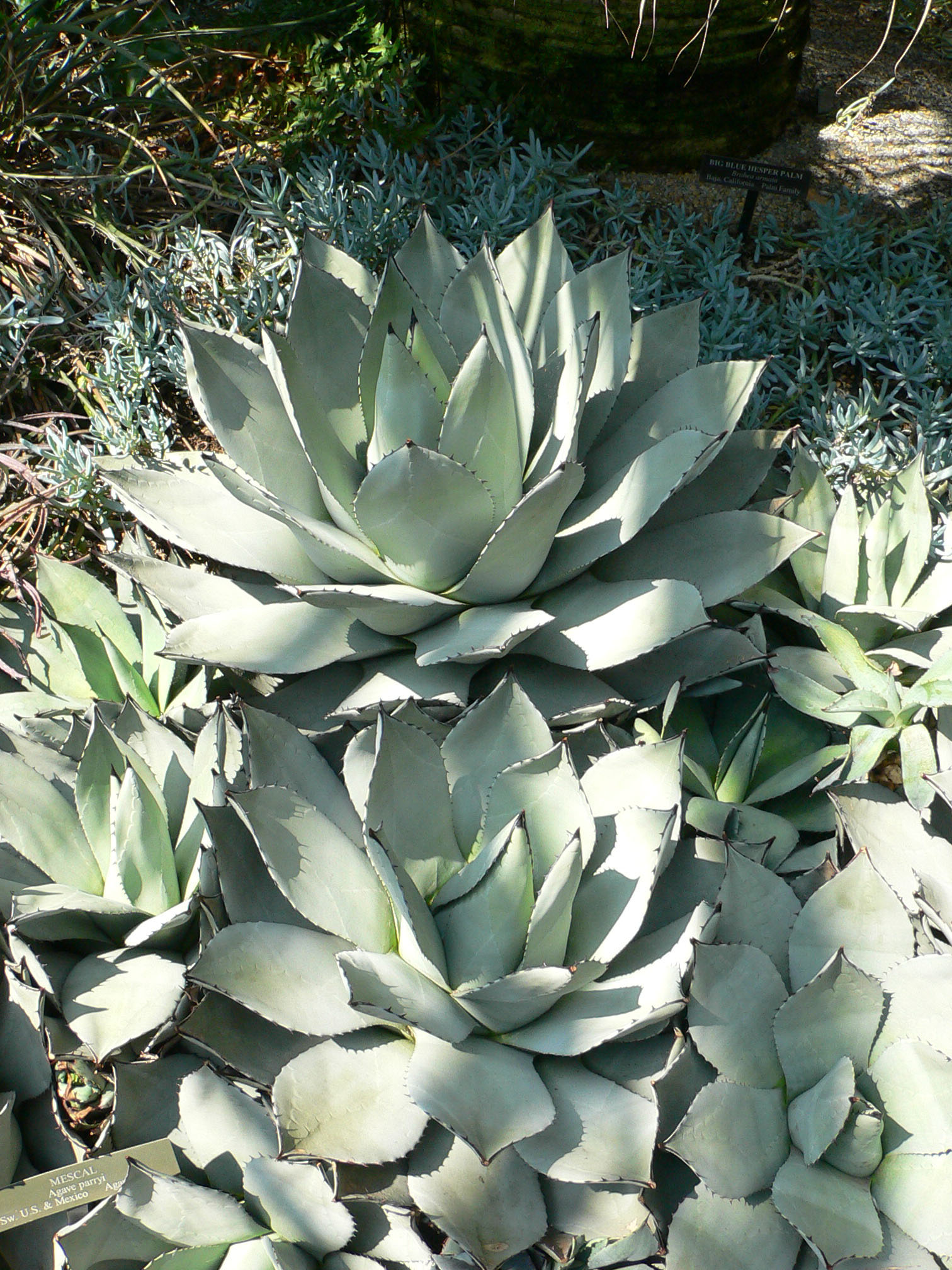
Agave parryi is one of the most cold-hardy species in the genus, making it particularly valuable for gardens in temperate and continental climates where other succulents would not survive. It forms a compact, symmetrical rosette of glaucous (silver-blue to grey) leaves 30–60 cm long with well-defined brown marginal teeth and a robust, dark apical spine. Native to the montane grasslands and pine-oak scrub of northwestern Mexico and the southwestern United States, it can tolerate prolonged frosts to −20 °C when the substrate is well-drained. Its candelabra inflorescence of 3–6 m with yellow-orange flowers is a natural spectacle of the first order.
chevron_right edit_note Proposed edits auto-approved at +3 net votes
No pending proposals for this section.
Overview
| Category | Classification |
|---|---|
| Family | Asparagaceae |
| Genus | Agave |
| Growth Habit | Compact medium-sized monocarpic rosette; produces basal offsets moderately |
| Conservation Status | Least Concern (LC) — stable though localized populations; some varieties under pressure from grassland loss |
| pH Target | 6.5 – 8.0 |
| Type | Stony or sandy, well-drained; tolerates neutral to slightly alkaline pH |
Origin & Habitat
Morphology
Obovate to lanceolate, glaucous (silver-blue), 30–60 cm × 8–15 cm; margins with brown corneous teeth 4–8 mm, well-spaced; robust black terminal spine 2–4 cm.
ecoYellow-orange with red tints externally, tubular, 5–7 cm, grouped in large branches on a panicle 3–6 m tall. Spring flowering lasting 2–3 weeks.
ecoShort, compact caudex; rarely forms a visible trunk, remaining as a ground-level rosette throughout its vegetative life.
ecoFibrous root system of moderate reach, very tolerant of summer drought and cold, dry winters.
ecochevron_right edit_note Proposed edits auto-approved at +3 net votes
No pending proposals for this section.
Requirements
Soil & Substrate
Type
Stony or sandy, well-drained; tolerates neutral to slightly alkaline pH
groups Beneficial Associations
chevron_right edit_note Proposed edits auto-approved at +3 net votes
No pending proposals for this section.
Propagation Strategy
- 1 Separate offsets 8–15 cm using thick gloves due to spines
- 2 Allow cut to callous in a dry location for 3–5 days
- 3 Plant in very free-draining substrate with 50% sand or grit
- 4 Water lightly the first week; then establish sparse watering regimen
Can be planted directly in the ground in climates with dry winters; avoid waterlogging at all costs
Planting in clay or poorly drained soil: guarantees plant loss in winter
Every 3–5 years
Once in spring with low-nitrogen cactus fertilizer
Uses & Applications
Precautions / Toxicity
Very sharp terminal spines capable of causing penetrating wounds. Corneous marginal teeth. Sap with saponins irritating to the skin.
chevron_right edit_note Proposed edits auto-approved at +3 net votes
No pending proposals for this section.
Plant Health
Agave weevil (Scyphophorus acupunctatus) — the most destructive insect of the genus; no effective cure once inside
Root rot from insufficient drainage during wet winter
chevron_right edit_note Proposed edits auto-approved at +3 net votes
No pending proposals for this section.
"It is probably the most widely grown agave in central and northern European climates due to its exceptional cold hardiness. The var. truncata has shorter, wider leaves with a highly contrasting grey-blue mark; var. huachucensis is larger and more robust."
chevron_right edit_note Proposed edits auto-approved at +3 net votes
No pending proposals for this section.
Scientific Integrity
🟡 MediumVote to help validate this record
Sources
Loading…
Discussion
Disclaimer
This species record is provided for educational and informational purposes only. Jardín Roca Negra does not guarantee the accuracy or completeness of the data. Content is community-curated and may be subject to revision; it should not replace advice from a qualified botanist. This species may be toxic, invasive, or subject to legal restrictions — verify before handling or cultivating. Jardín Roca Negra accepts no liability for any harm arising from reliance on this information. Images are reproduced under Creative Commons or equivalent free licenses; credits are noted below each image.