
Aichryson tortuosum (Aiton) A.Berger
Twisted aeonium
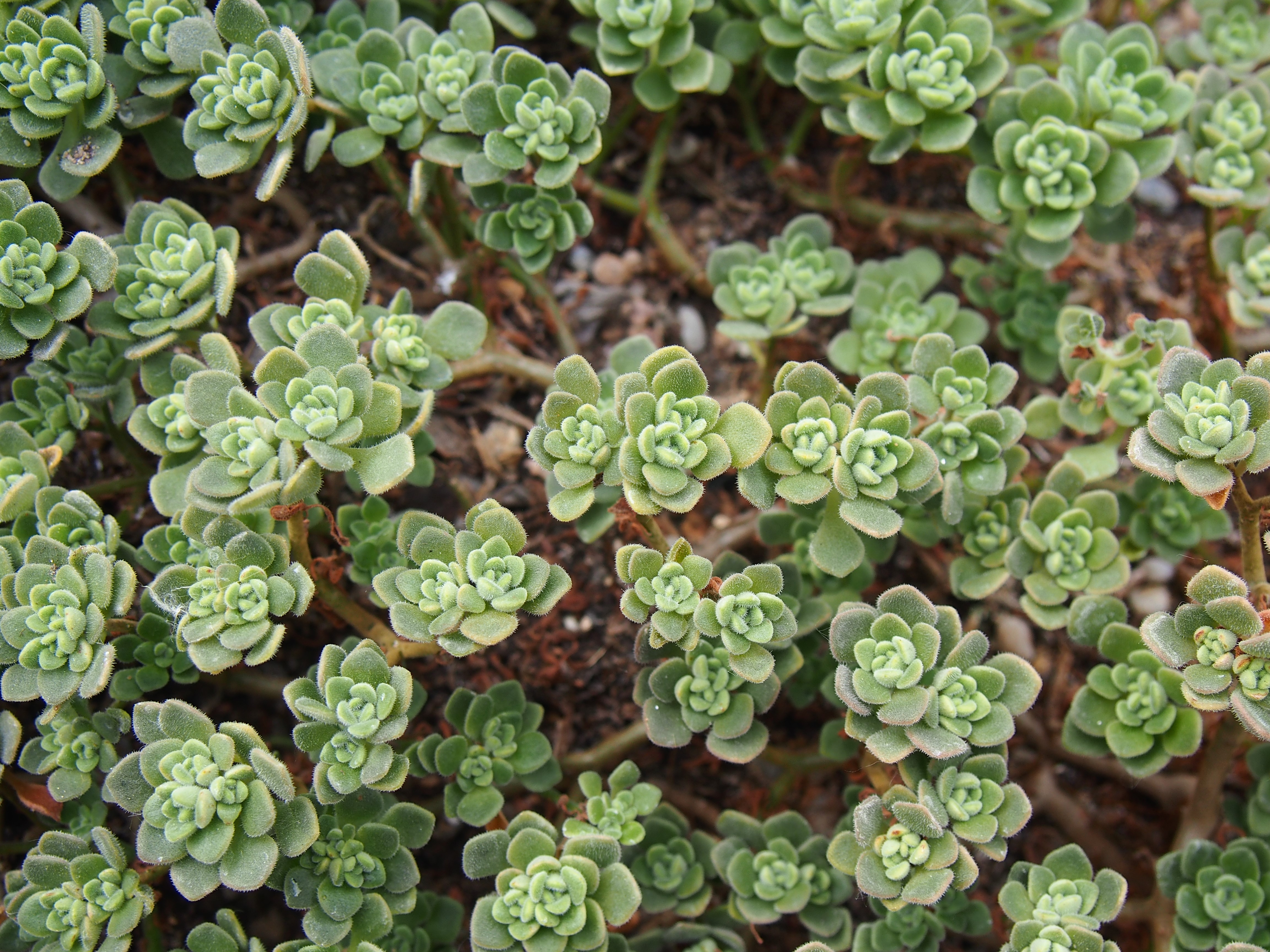
Aichryson tortuosum (Aiton) A.Berger, commonly known as 'twisted aeonium' or 'twisted bejeque', is an annual or biennial succulent of the family Crassulaceae, endemic to Lanzarote and Fuerteventura. Although historically included in the genus Aeonium as 'Aeonium tortuosum', modern taxonomy places it in the genus Aichryson, distinguished by its 5-petalled flowers and alternate leaves. Its zigzagging stems and small rosettes give it a peculiar, unmistakeable appearance.
chevron_right edit_note Proposed edits auto-approved at +3 net votes
No pending proposals for this section.
Overview
| Category | Classification |
|---|---|
| Family | Crassulaceae |
| Genus | Aeonium |
| Growth Habit | Annual or biennial succulent to 20–35 cm tall, with zigzagging, highly branched stems and alternate leaves arranged in lax terminal rosettes. It behaves as a winter-growing plant, germinating in autumn and dying after flowering in spring. |
| Conservation Status | Least Concern (LC) per IUCN; endemic to Lanzarote and Fuerteventura with stable populations in well-preserved arid habitats. |
| pH Target | 6.0 – 7.5 |
| Type | Sandy, mineral, nutrient-poor, very well-drained |
Origin & Habitat
Morphology
Alternate leaves (not in a closed rosette as in Aeonium), oblong-spatulate, 1–3 cm, fleshy, greyish-green with a glandular-sticky surface. They loosely cluster at branch tips forming open pseudo-rosettes.
ecoSmall flowers with 5 bright yellow petals (the character that distinguishes it from Aeonium, which has 7–11 petals), grouped in terminal cymes 5–15 cm. Flowers January to April. The plant dies after flowering, being annual/biennial.
ecoSlender, zigzagging, highly branched stems from the base, green to reddish, with an interesting twisted pattern that gives the species its name ('tortuosum'). The base may become slightly woody in second-year plants.
ecoShallow, fibrous root system. Being annual, the root system is simple and does not store significant reserves; leaf succulence is the main water reserve.
ecochevron_right edit_note Proposed edits auto-approved at +3 net votes
No pending proposals for this section.
Requirements
Soil & Substrate
Type
Sandy, mineral, nutrient-poor, very well-drained
groups Beneficial Associations
chevron_right edit_note Proposed edits auto-approved at +3 net votes
No pending proposals for this section.
Propagation Strategy
- 1 Harvest seeds when fruits turn brown and dry (May–June).
- 2 Store in paper in a cool, dry place until September.
- 3 Sow on the surface of very slightly moist fine sandy substrate.
- 4 Keep at 18–22 °C with bright natural light.
- 5 Germination in 10–20 days; thin seedlings to 5–8 cm apart.
- 6 Transplant individually to 8 cm pots when 3–4 cm tall.
Being annual/biennial, plan for annual renewal by seed.
Trying to keep the plant alive after flowering — the natural cycle ends with death.
Not applicable (annual/biennial plant); renew by seed each year.
No fertiliser or a very low dose (10% of recommended) once in winter. Excess fertiliser produces etiolated, weak plants.
Uses & Applications
Precautions / Toxicity
No known toxic properties relevant to humans or domestic animals.
chevron_right edit_note Proposed edits auto-approved at +3 net votes
No pending proposals for this section.
Plant Health
Crown rot from overwatering in summer — the main risk in cultivation.
Whitefly (Trialeurodes vaporariorum) in warm, humid conditions.
chevron_right edit_note Proposed edits auto-approved at +3 net votes
No pending proposals for this section.
"TAXONOMIC NOTE: The currently accepted correct name is Aichryson tortuosum (Aiton) A.Berger. The name 'Aeonium tortuosum' is a historical synonym. The genus Aichryson is distinguished from Aeonium mainly by its pentamerous flowers (5 petals vs. 7–11), alternate leaves, and annual or biennial life cycle. This entry is included under genusId 5 (Aeonium) for historical continuity and ease of searching."
chevron_right edit_note Proposed edits auto-approved at +3 net votes
No pending proposals for this section.
Scientific Integrity
🟡 MediumVote to help validate this record
Sources
Loading…
Discussion
Disclaimer
This species record is provided for educational and informational purposes only. Jardín Roca Negra does not guarantee the accuracy or completeness of the data. Content is community-curated and may be subject to revision; it should not replace advice from a qualified botanist. This species may be toxic, invasive, or subject to legal restrictions — verify before handling or cultivating. Jardín Roca Negra accepts no liability for any harm arising from reliance on this information. Images are reproduced under Creative Commons or equivalent free licenses; credits are noted below each image.