
Adromischus juttae
Jutta's Adromischus
Adromischus juttae (Poelln.) is a compact succulent belonging to the family Crassulaceae, classified as a subspecies or variant of Adromischus schuldtianus. It is native to the arid regions of Namibia and the Western Cape of South Africa, where it grows among quartzitic rocks and in stony soils with very low water retention. Its ovate, slightly compressed leaves have a waxy surface of greyish-green color, sometimes with diffuse purplish spots under high solar irradiation conditions. It is a slow-growing plant, highly appreciated in specialized collections of southern African succulents.
chevron_right edit_note Proposed edits auto-approved at +3 net votes
No pending proposals for this section.
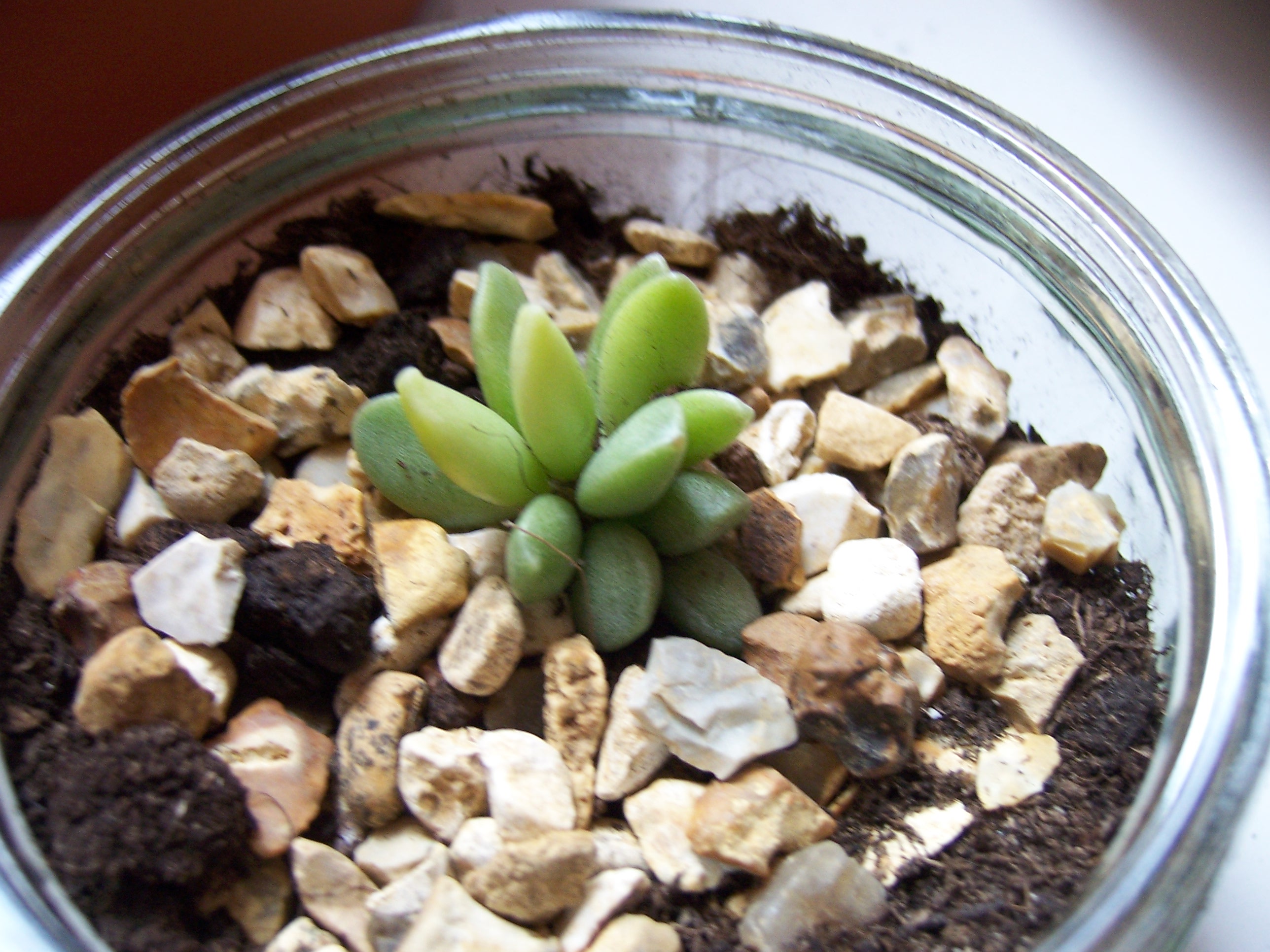
© Stephen Boisvert
CC BY 2.0
Overview
| Category | Classification |
|---|---|
| Family | Crassulaceae |
| Genus | Adromischus |
| Growth Habit | Perennial herbaceous succulent, compact and low-growing, with short stems and sparse basal branching. |
| Conservation Status | Not Evaluated (NE) by the IUCN; no major known threats within its natural distribution area. |
| pH Target | 6.0–7.0 |
| Type | Sandy-stony mineral substrate, extremely well-draining, poor in organic matter, similar to its natural habitat in the Namib desert and the Karoo. |
Origin & Habitat
Morphology
Succulent leaves, ovate to oblong, 2–4 cm long and 1–2 cm wide, slightly dorsoventrally compressed. Adaxial surface flat to slightly concave, covered by a waxy greyish-green or bluish-green cuticle. Under high irradiation or water stress they may develop diffuse purplish or reddish tints. Entire margins, obtuse or rounded apex.
ecoSmall tubular flowers, whitish-pink to pale pink, grouped in a terminal spike on a slender peduncle of 10–20 cm. Calyx with 5 short sepals; corolla with 5 petals fused into a tube. Flowering in spring-summer (August–November in the southern hemisphere).
ecoShort stem, semi-woody at the base, 2–5 cm long, tending to lignify with age. Sparse branching, generally from the base. The epidermis is grayish-brown on the exposed basal parts.
ecoFibrous and shallow root system, adapted to stony shallow soils. Under optimal conditions it may develop slightly thickened roots with moderate water storage capacity.
ecochevron_right edit_note Proposed edits auto-approved at +3 net votes
No pending proposals for this section.
Requirements
Soil & Substrate
Type
Sandy-stony mineral substrate, extremely well-draining, poor in organic matter, similar to its natural habitat in the Namib desert and the Karoo.
groups Beneficial Associations
chevron_right edit_note Proposed edits auto-approved at +3 net votes
No pending proposals for this section.
Propagation Strategy
- 1 Remove a healthy, well-developed leaf with a clean lateral twisting motion to keep the base intact.
- 2 Let the cut end dry in a shaded, well-ventilated spot for 3–5 days until a dry callus forms.
- 3 Place the leaf horizontally on dry or slightly moist mineral substrate, without burying it.
- 4 Maintain at 20–25 °C with bright indirect light; avoid direct watering during the first weeks.
- 5 Adventitious roots appear in 3–6 weeks; transplant when the seedling is 1–2 cm in diameter.
- 1 Sow on the surface of slightly moistened fine mineral substrate; do not cover the seeds.
- 2 Keep under a transparent cover at 22–26 °C with bright indirect light to maintain ambient humidity.
- 3 Germination occurs in 2–4 weeks. Gradually remove the cover once germinated to prevent fungal issues.
- 4 Transplant seedlings into individual pots when they reach 1 cm in diameter (3–5 months).
Use unglazed terracotta pots to promote lateral substrate evaporation and reduce waterlogging risk.
Watering too frequently in winter: roots rot quickly in cold, moist substrate.
Every 2–3 years in spring, when roots have completely filled the current pot.
Once a month during the active growing season (spring-summer) with liquid cactus and succulent fertilizer diluted to 25% of the recommended dose. Suspend completely in autumn and winter.
Uses & Applications
Precautions / Toxicity
No significant toxicity is known for humans or domestic animals. It is recommended to keep it out of reach of pets as a precaution.
chevron_right edit_note Proposed edits auto-approved at +3 net votes
No pending proposals for this section.
Plant Health
Root rot: caused by Phytophthora spp. or Pythium spp. due to overwatering or compacted substrate. Symptoms: soft, darkened stem base, leaves that fall off easily. Prevent with very well-draining substrate and spaced watering.
Root mealybugs (Rhizoecus spp.): mealy insects that colonize the roots and stem base. Difficult to detect until the plant shows general weakening. Treat with systemic insecticide diluted in watering water.
chevron_right edit_note Proposed edits auto-approved at +3 net votes
No pending proposals for this section.
"A. juttae was originally described by Poellnitz and subsequently treated as a subspecies of A. schuldtianus by several modern authors. Its taxonomy within the schuldtianus complex remains under revision. Cultivated specimens show greater leaf variability than wild populations in Namibia."
chevron_right edit_note Proposed edits auto-approved at +3 net votes
No pending proposals for this section.
Scientific Integrity
🟡 MediumVote to help validate this record
Sources
Loading…
Discussion
Disclaimer
This species record is provided for educational and informational purposes only. Jardín Roca Negra does not guarantee the accuracy or completeness of the data. Content is community-curated and may be subject to revision; it should not replace advice from a qualified botanist. This species may be toxic, invasive, or subject to legal restrictions — verify before handling or cultivating. Jardín Roca Negra accepts no liability for any harm arising from reliance on this information. Images are reproduced under Creative Commons or equivalent free licenses; credits are noted below each image.