
Sempervivum arachnoideum L.
Cobweb Houseleek
Sempervivum arachnoideum, known as 'cobweb houseleek' or 'spider web houseleek', is a succulent in the family Crassulaceae described by Linnaeus in 1753, native to the alpine and subalpine regions of the Alps, Pyrenees, Apennines, and Carpathians, where it grows at elevations of 1,000–3,000 m. Its most recognizable feature is the dense network of white filaments connecting the leaf tips, forming a 'cobweb' cover that gives it a unique and unmistakable appearance. The rosettes are small, only 3–5 cm in diameter, and form prolific dense colonies.
chevron_right edit_note Proposed edits auto-approved at +3 net votes
No pending proposals for this section.
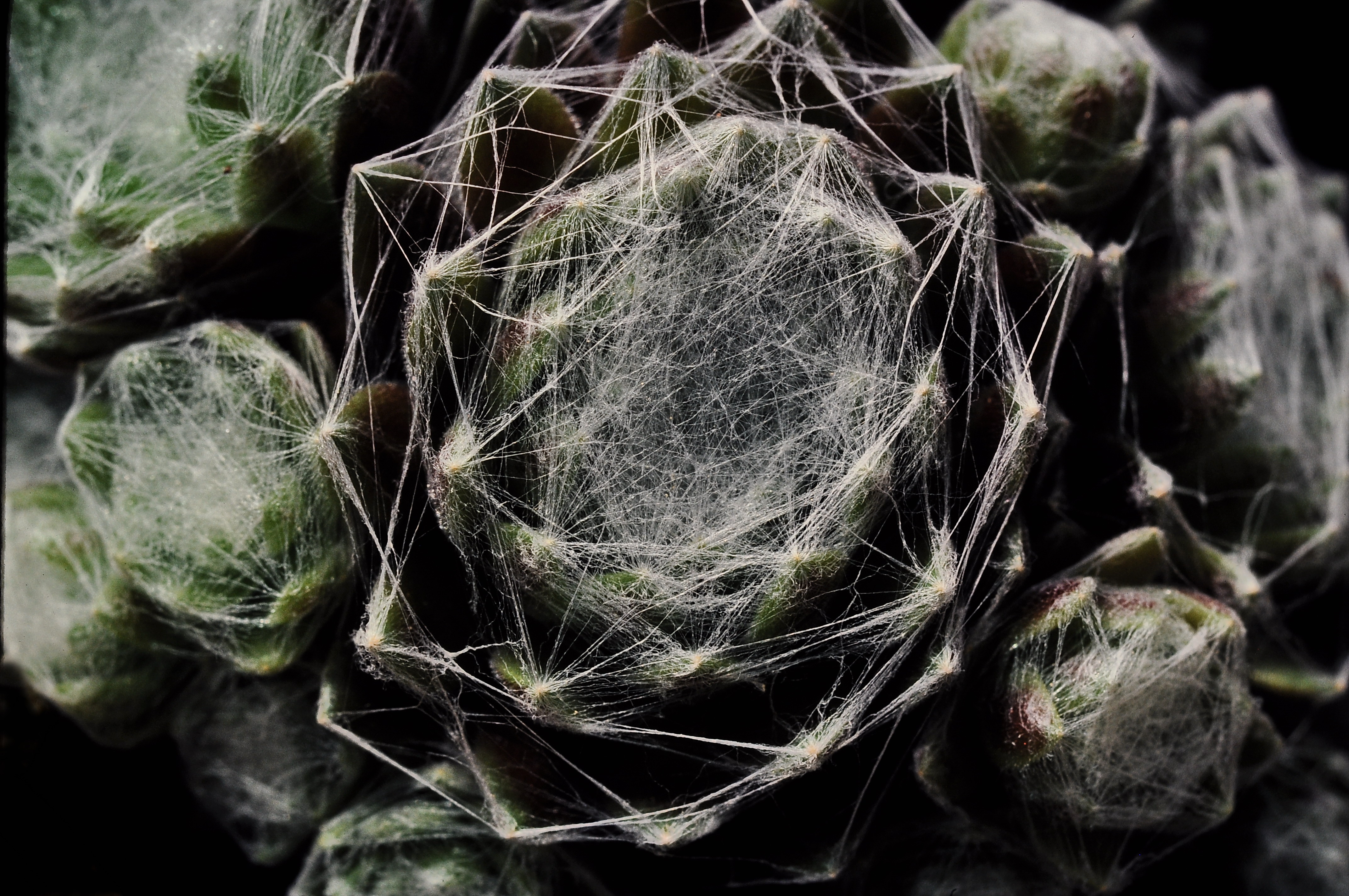
© Manuel Werner
CC BY-SA 3.0
Overview
| Category | Classification |
|---|---|
| Family | Crassulaceae |
| Genus | Sempervivum |
| Growth Habit | Very small (3–5 cm) monocarpic rosettes that are extremely prolific offset producers; a mature plant can produce dozens of offsets per year, forming dense carpets. One of the fastest-growing sempervivums. |
| Conservation Status | Least Concern (LC). Abundant in its natural alpine habitats and widely cultivated in gardens worldwide. |
| pH Target | 5.5 – 7.5 |
| Type | Very poor and mineral soil, gravel, crushed rock, or mountain soil. No significant organic matter. Perfect drainage. |
Origin & Habitat
Morphology
Oblanceolate leaves, 1–2.5 cm long, medium green to reddish-green, with acute tips connected by a dense network of long white trichomes forming the characteristic 'cobweb'. Beneath the web, the leaf may be green or tinged red depending on exposure.
ecoInflorescence on a stalk 10–20 cm tall. Star-shaped flowers with 10–14 bright pink to pink-magenta petals, appearing in summer. The rosette flowers and dies (monocarpic), replaced by offsets.
ecoShort floral stalk, densely hairy and glandular. The vegetative rosette is stemless. Stolons are very short and numerous, producing a very dense carpet.
ecoVery shallow and fibrous root system, adapted to the minimal soil depth of rocky alpine habitats. Roots penetrate the smallest substrate crevices.
ecochevron_right edit_note Proposed edits auto-approved at +3 net votes
No pending proposals for this section.
Requirements
Soil & Substrate
Type
Very poor and mineral soil, gravel, crushed rock, or mountain soil. No significant organic matter. Perfect drainage.
groups Beneficial Associations
chevron_right edit_note Proposed edits auto-approved at +3 net votes
No pending proposals for this section.
Propagation Strategy
- 1 The plant produces dozens of offsets per year; separate them with scissors by cutting the stolon.
- 2 Plant directly in poor mineral substrate or in rock and wall crevices.
- 3 Water only once; they establish on their own in 1–2 weeks.
Plant in wall crevices or between stones to recreate the natural habitat and obtain the best appearance.
Using fertile or peat substrate that produces large, soft rosettes with sparse cobwebs.
Every 3–4 years or when the clump completely overflows the pot; simply divide and replant.
No fertilization recommended; any nutrient input reduces cobweb density and rosette compactness.
Uses & Applications
Precautions / Toxicity
Non-toxic. Like S. tectorum, classified as non-toxic to humans and pets. The leaves have similar ethnobotanical use as a topical soothing agent.
chevron_right edit_note Proposed edits auto-approved at +3 net votes
No pending proposals for this section.
Plant Health
Sempervivum mite (Brevipalpus sp.): may damage the central leaves and destroy the 'cobweb'; treat with a systemic acaricide.
Rosette rot from stagnant moisture, especially in winter with above-zero temperatures.
chevron_right edit_note Proposed edits auto-approved at +3 net votes
No pending proposals for this section.
"The trichomes forming the 'cobweb' of Sempervivum arachnoideum are specialized structures derived from leaf epidermal hairs, biochemically distinct from the glandular trichomes of other sempervivums. These filaments have been shown to act as fog condensers: water from alpine clouds and nocturnal fog deposits on them and drains toward the rosette base, providing a critical water supplement in the alpine habitat where summer rains are scarce. This biophysical adaptation is unique within the genus Sempervivum."
chevron_right edit_note Proposed edits auto-approved at +3 net votes
No pending proposals for this section.
Scientific Integrity
🟡 MediumVote to help validate this record
Sources
Loading…
Discussion
Disclaimer
This species record is provided for educational and informational purposes only. Jardín Roca Negra does not guarantee the accuracy or completeness of the data. Content is community-curated and may be subject to revision; it should not replace advice from a qualified botanist. This species may be toxic, invasive, or subject to legal restrictions — verify before handling or cultivating. Jardín Roca Negra accepts no liability for any harm arising from reliance on this information. Images are reproduced under Creative Commons or equivalent free licenses; credits are noted below each image.