
Kalanchoe luciae Raym.-Hamet
Paddle Plant / Flapjacks / Desert Cabbage
Kalanchoe luciae is a monocarpic succulent native to southern Africa (South Africa, Swaziland, Lesotho, and Mozambique), famed for its large rosettes of rounded, flattened, grayish-green leaves that flush deep red at the margins when exposed to direct sun or cold. Its epithet honors Mademoiselle Lucy Dufour, an acquaintance of the French botanist Raymond Hamet.
chevron_right edit_note Proposed edits auto-approved at +3 net votes
No pending proposals for this section.
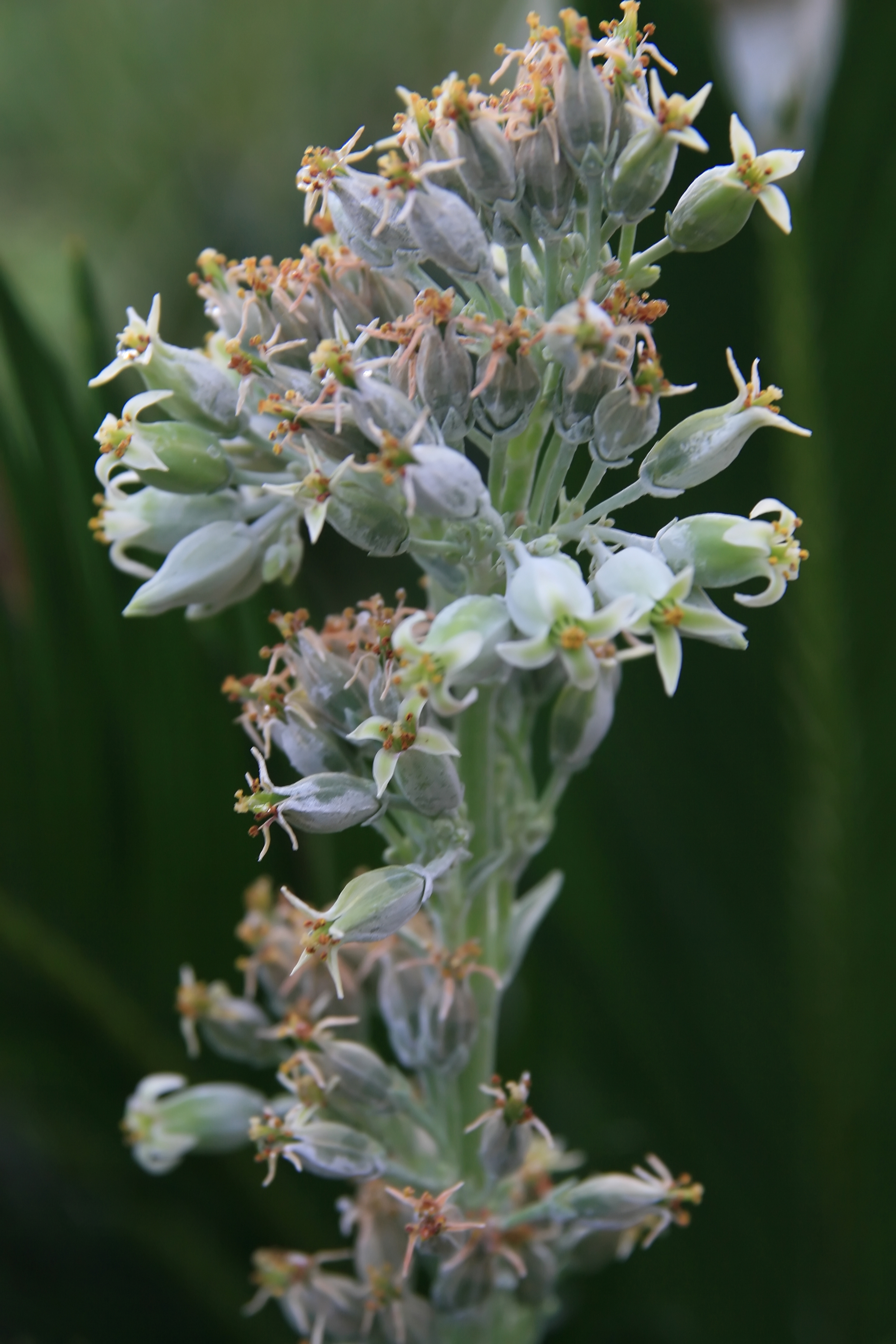
© Mokkie
CC BY-SA 4.0
Overview
| Category | Classification |
|---|---|
| Family | Crassulaceae |
| Genus | Kalanchoe |
| Growth Habit | Monocarpic succulent with a compact basal rosette; after flowering, the mother rosette dies and produces lateral offsets. |
| Conservation Status | No threat category; globally cultivated; stable in its native range. |
| pH Target | 6.0 – 7.5 |
| Type | Sandy-loam to sandy, very well-drained; tolerates calcareous rocky soils. |
Origin & Habitat
Morphology
Obovate, thick, fleshy leaves 10–20 cm long and 6–15 cm wide, arranged in a rosette; grayish-green with a white powdery bloom and margins that flush pink-red under light or water stress. Leaves orient their narrow edge toward the midday sun, reducing direct radiation interception.
ecoVery short, compressed stem in the vegetative rosette; upon reaching reproductive maturity, it generates an erect flowering scape up to 90 cm tall bearing the inflorescence.
ecoDense terminal panicle on the scape; urceolate-tubular flowers 1.2–1.5 cm, white to greenish-yellow, with 8 stamens clearly exserted; scentless; produced only once in the rosette's lifetime.
ecoModerately deep fibrous roots; the plant requires very well-drained substrate to avoid crown rot in humid conditions.
ecochevron_right edit_note Proposed edits auto-approved at +3 net votes
No pending proposals for this section.
Requirements
Soil & Substrate
Type
Sandy-loam to sandy, very well-drained; tolerates calcareous rocky soils.
groups Beneficial Associations
chevron_right edit_note Proposed edits auto-approved at +3 net votes
No pending proposals for this section.
Propagation Strategy
- 1 Identify basal offsets when they have at least 3–4 leaves.
- 2 Detach with a sterile blade in spring.
- 3 Allow to callus for 2–3 days.
- 4 Plant in well-draining succulent substrate; water after 7–10 days.
- 1 Remove a paddle leaf from the base, making sure to obtain the complete insertion.
- 2 K. luciae leaves are large and heavy; lay them horizontally on fine substrate.
- 3 Callus for 3–5 days before placing on substrate.
- 4 Maintain at 22–26 °C with gentle direct light; result visible in 8–14 weeks.
WARNING: toxic to dogs and cats. The red leaf coloration intensifies with sun stress or mild cold.
Not removing the dead mother rosette after flowering, promoting rot at the base of offsets.
Every 2 years in spring. Moderate-growing species that produces offsets that will fill the pot.
Low-N, high K-P fertilizer (e.g. 5-15-15) monthly from March to September to enhance leaf color. No fertilization in winter.
Uses & Applications
Precautions / Toxicity
TOXIC to cats and dogs; can cause vomiting, diarrhea, and cardiac arrhythmia if ingested. Low toxicity for adult humans, but keep away from children and pets.
chevron_right edit_note Proposed edits auto-approved at +3 net votes
No pending proposals for this section.
"The red coloration of K. luciae leaf margins under stress is due to anthocyanin accumulation, which acts as a photoprotective screen against high UV irradiation; this mechanism involves regulation of CHS (chalcone synthase) and F3H (flavanone 3-hydroxylase) genes activated by stress signals, a relevant model in plant molecular biology."
chevron_right edit_note Proposed edits auto-approved at +3 net votes
No pending proposals for this section.
Scientific Integrity
🟡 MediumVote to help validate this record
Sources
Loading…
Discussion
Disclaimer
This species record is provided for educational and informational purposes only. Jardín Roca Negra does not guarantee the accuracy or completeness of the data. Content is community-curated and may be subject to revision; it should not replace advice from a qualified botanist. This species may be toxic, invasive, or subject to legal restrictions — verify before handling or cultivating. Jardín Roca Negra accepts no liability for any harm arising from reliance on this information. Images are reproduced under Creative Commons or equivalent free licenses; credits are noted below each image.