
Crassula perforata Thunb.
String of Buttons / Necklace Vine
Crassula perforata, known as "string of buttons" or "necklace vine", is an erect to trailing succulent native to the Cape region of South Africa. Its most striking feature is the arrangement of leaves, which are threaded around the stem so that the stem appears to pass through the centre of each leaf pair, creating the appearance of a chain or necklace. It is widely cultivated as a hanging or pot ornamental.
chevron_right edit_note Proposed edits auto-approved at +3 net votes
No pending proposals for this section.
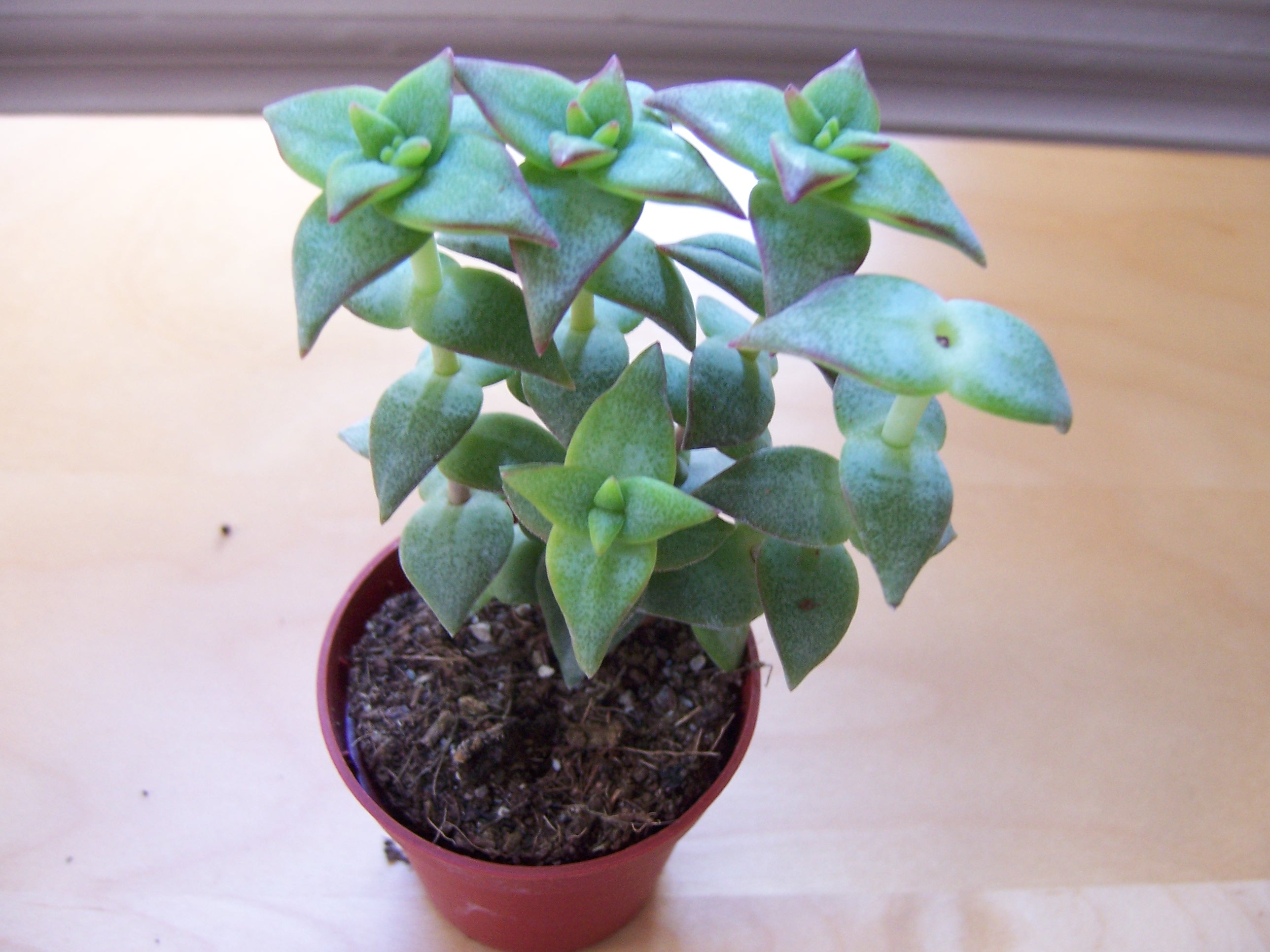
© Agnieszka Kwiecień, Nova
CC BY-SA 4.0
Overview
| Category | Classification |
|---|---|
| Family | Crassulaceae |
| Genus | Crassula |
| Growth Habit | Climbing-trailing succulent |
| Conservation Status | Least Concern |
| pH Target | 6.0 – 7.0 |
| Type | Sandy-porous, excellent drainage, low organic matter content |
Origin & Habitat
Morphology
Triangular to ovate, fleshy leaves 1–3 cm long, grey-green to blue-green in colour with very attractive pink or reddish margins, arranged in decussate pairs that completely clasp the stem. Leaves of specimens in full sun develop more intense pink tones, while those in shade remain a dull green.
ecoSlender stems, 2–5 mm in diameter, initially erect but becoming pendant as they lengthen, reaching up to 60–90 cm. Mature stems become slightly woody at the base and produce branches that give the plant a bushy appearance.
ecoTerminal inflorescences with small white to cream flowers 4–5 mm in diameter, clustered in loose corymbs. They bloom in spring and summer; though modest, the flowers emit a soft fragrance.
ecoFibrous, compact root system that adapts well to small pots. Produces adventitious roots at stem nodes when these come into contact with moist substrate, facilitating propagation by cuttings.
ecochevron_right edit_note Proposed edits auto-approved at +3 net votes
No pending proposals for this section.
Requirements
Soil & Substrate
Type
Sandy-porous, excellent drainage, low organic matter content
groups Beneficial Associations
chevron_right edit_note Proposed edits auto-approved at +3 net votes
No pending proposals for this section.
Propagation Strategy
- 1 Cut a stem segment 8–12 cm long with sterilised scissors, including several pairs of stacked perfoliate leaves.
- 2 The leaves are threaded onto the stem; only remove the basal pair to expose the node.
- 3 Allow to cure for 2–3 days.
- 4 Plant in cactus mix; the stacked leaves make the cutting very stable.
- 5 Water moderately and place in bright indirect light.
- 1 Remove the plant from its pot in spring; C. perforata branches abundantly and forms dense clumps.
- 2 Separate individual stem-rosettes with fingers or a sterilised knife, ensuring each has roots.
- 3 Allow any cuts to dry for 1–2 days.
- 4 Plant each division in an individual pot with cactus mix.
The stacked perfoliate leaves are its most striking feature; the plant grows in a cascading manner, making it ideal for tall pots or shelves.
Not providing enough sunlight, causing etiolation and loss of the red leaf margins.
Repot or divide every 2 years in spring; C. perforata forms dense clumps quickly and benefits from regular substrate renewal.
Fertilise once a month in spring and summer with succulent fertiliser at 50% dose. No fertilising in autumn and winter.
Uses & Applications
Precautions / Toxicity
Low toxicity; may cause mild gastrointestinal irritation in pets if ingested in large quantities.
chevron_right edit_note Proposed edits auto-approved at +3 net votes
No pending proposals for this section.
"Crassula perforata is one of the most easily hybridised species in the genus; the cross C. rupestris × C. perforata, known as 'Baby Necklace', is widely sold in the succulent trade and is more vigorous than either parent."
chevron_right edit_note Proposed edits auto-approved at +3 net votes
No pending proposals for this section.
Scientific Integrity
🟡 MediumVote to help validate this record
Sources
Loading…
Discussion
Disclaimer
This species record is provided for educational and informational purposes only. Jardín Roca Negra does not guarantee the accuracy or completeness of the data. Content is community-curated and may be subject to revision; it should not replace advice from a qualified botanist. This species may be toxic, invasive, or subject to legal restrictions — verify before handling or cultivating. Jardín Roca Negra accepts no liability for any harm arising from reliance on this information. Images are reproduced under Creative Commons or equivalent free licenses; credits are noted below each image.