
Echeveria elegans Rose
Mexican Snowball
Echeveria elegans, commonly known as 'Mexican snowball', is a rosette-forming succulent in the family Crassulaceae, native to the states of Hidalgo and San Luis Potosí, Mexico. Its leaves are pale blue-green to silvery grey, obovate, and tipped with a small mucro, arranged in a tight, symmetrical rosette 10–15 cm in diameter. It is one of the most widely cultivated echeverias worldwide due to its ease of propagation and tolerance of suboptimal growing conditions.
chevron_right edit_note Proposed edits auto-approved at +3 net votes
No pending proposals for this section.
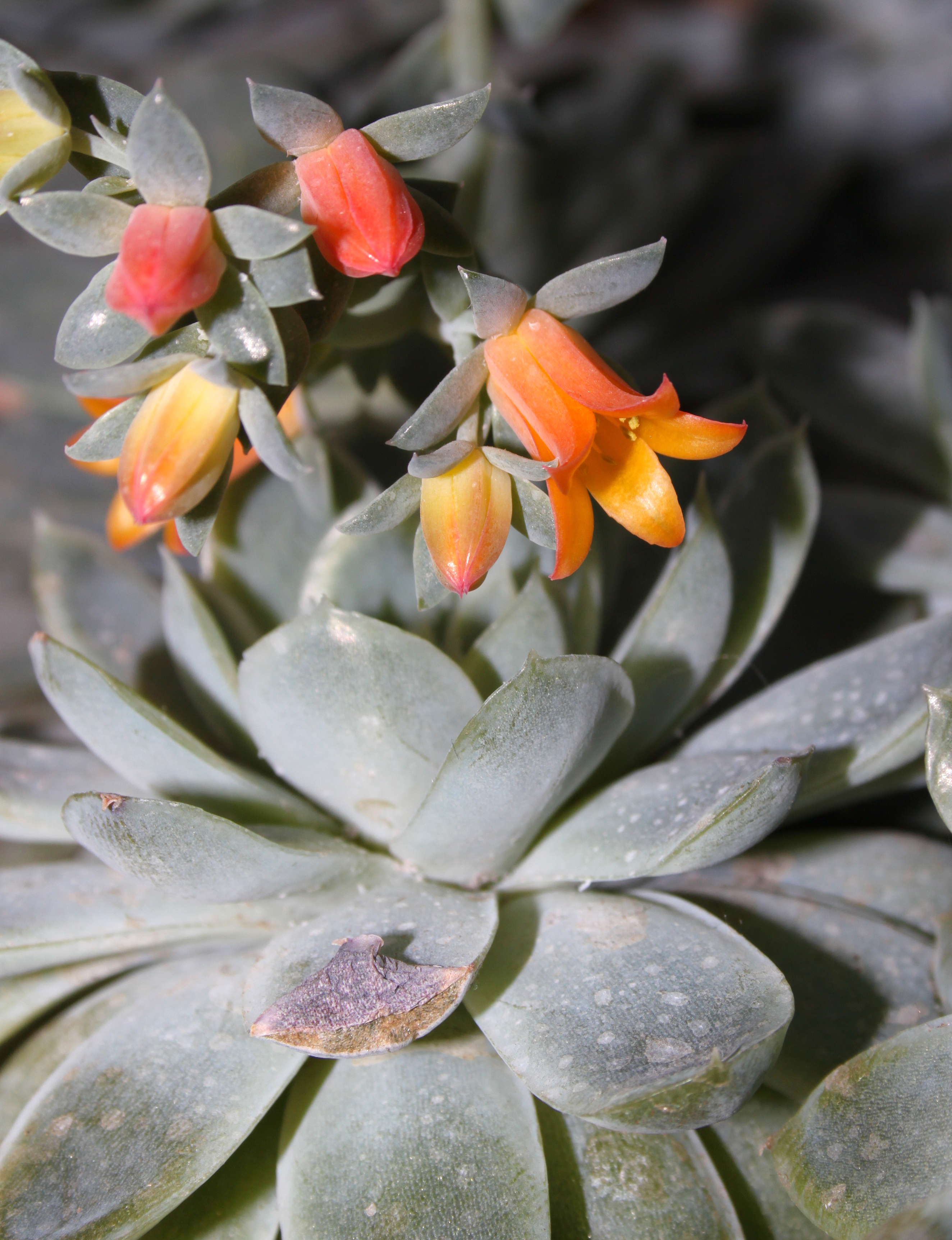
© Diego Delso
CC BY-SA 3.0
Overview
| Category | Classification |
|---|---|
| Family | Crassulaceae |
| Genus | Echeveria |
| Growth Habit | Compact, stemless rosette that forms dense colonies through continuous production of basal offsets. Growth rate is slow to moderate; mature specimens can reach up to 15 cm in diameter. |
| Conservation Status | Not listed under any global threat category (LC – Least Concern per IUCN). Widely cultivated as an ornamental and its wild populations in Mexico are considered stable. |
| pH Target | 6.0 – 7.0 |
| Type | Mineral, loose, highly porous soil with low water retention. Preferably based on volcanic gravel (tezontle, perlite) mixed with cactus substrate. Slightly acidic to neutral pH. |
Origin & Habitat
Morphology
Fleshy, obovate to spatulate leaves, 3–5 cm long, pale blue-green to silvery white due to a waxy pruinose coating. Apex rounded with a small translucent mucro. Margins are entire and slightly translucent.
ecoInflorescence a scorpioid cyme on a floral stalk 15–20 cm tall. Bell-shaped flowers with 5 petals, pink-orange with yellow tips, blooming in winter–spring and very attractive to hummingbirds.
ecoStem very short to virtually absent in young plants; may elongate to 5–8 cm with age or under low-light conditions (etiolation). Produces short stolons terminating in daughter rosettes.
ecoFibrous and shallow root system, adapted to rocky soils with low nutrient content. Roots are thin and spread horizontally to maximize uptake of rainfall.
ecochevron_right edit_note Proposed edits auto-approved at +3 net votes
No pending proposals for this section.
Requirements
Soil & Substrate
Type
Mineral, loose, highly porous soil with low water retention. Preferably based on volcanic gravel (tezontle, perlite) mixed with cactus substrate. Slightly acidic to neutral pH.
groups Beneficial Associations
chevron_right edit_note Proposed edits auto-approved at +3 net votes
No pending proposals for this section.
Propagation Strategy
- 1 Remove a healthy leaf with a gentle twisting motion to ensure the basal meristem remains intact.
- 2 Allow the cut end to callous for 24–48 hours in a shaded, well-ventilated location.
- 3 Place the leaf on dry substrate or insert the base slightly into the medium; do not bury more than 2–3 mm.
- 4 Mist lightly every 3–5 days and await the emergence of roots and a new rosette (3–8 weeks).
- 1 Separate the offset from the mother rosette by hand or with a sterile knife, ensuring it retains some roots.
- 2 Allow the cut to callous for 12–24 hours, then plant in dry substrate.
- 3 Begin moderate watering one week after transplanting.
Rotate the pot 90° every week to maintain the perfect rosette symmetry.
Overwatering, especially in winter, causing basal rot.
Every 2–3 years in spring when roots fill the pot or the rosette outgrows the container.
Liquid cactus and succulent fertilizer at half the recommended dose, once in spring and once in early summer; withhold entirely in autumn and winter.
Uses & Applications
Precautions / Toxicity
Non-toxic to humans, dogs, and cats according to the ASPCA and major toxicological registries. Safe in households with pets and children.
chevron_right edit_note Proposed edits auto-approved at +3 net votes
No pending proposals for this section.
Plant Health
Mealybug (Planococcus citri): colonizes leaf axils; treat with 70% isopropyl alcohol on a cotton swab or systemic insecticide.
Root rot from overwatering or compacted substrate with poor drainage.
Thrips (Frankliniella spp.): causes silvery discoloration on new leaves; control with neem oil or spinosad.
chevron_right edit_note Proposed edits auto-approved at +3 net votes
No pending proposals for this section.
"Echeveria elegans was described by Joseph Nelson Rose in 1903 from material collected in Hidalgo. Its epithet 'elegans' refers to the elegant symmetry of its rosette, and it is the type species that popularized the genus in European and Asian horticulture. Notably, the waxy pruina on its leaves acts as a natural UV filter that reflects the intense solar radiation of the Mexican plateaus."
chevron_right edit_note Proposed edits auto-approved at +3 net votes
No pending proposals for this section.
Scientific Integrity
🟡 MediumVote to help validate this record
Sources
Loading…
Discussion
Disclaimer
This species record is provided for educational and informational purposes only. Jardín Roca Negra does not guarantee the accuracy or completeness of the data. Content is community-curated and may be subject to revision; it should not replace advice from a qualified botanist. This species may be toxic, invasive, or subject to legal restrictions — verify before handling or cultivating. Jardín Roca Negra accepts no liability for any harm arising from reliance on this information. Images are reproduced under Creative Commons or equivalent free licenses; credits are noted below each image.