
Brunsvigia toxicaria (L.f. ex Aiton) Ker Gawl.
Toxic Brunsvigia
Perennial bulbous geophyte of the Amaryllidaceae family, described by Ker Gawler from Cape material. This taxon is currently subject to taxonomic controversy: some authors synonymise it with Boophone disticha (L.f.) Herb., while others maintain Brunsvigia toxicaria as an independent species or treat it as Crossyne flava. The name 'toxicaria' reflects the plant's notorious toxicity, recognised since its earliest descriptions. It produces pink to red flowers in dense umbels on robust scapes during the austral summer.
chevron_right edit_note Proposed edits auto-approved at +3 net votes
No pending proposals for this section.
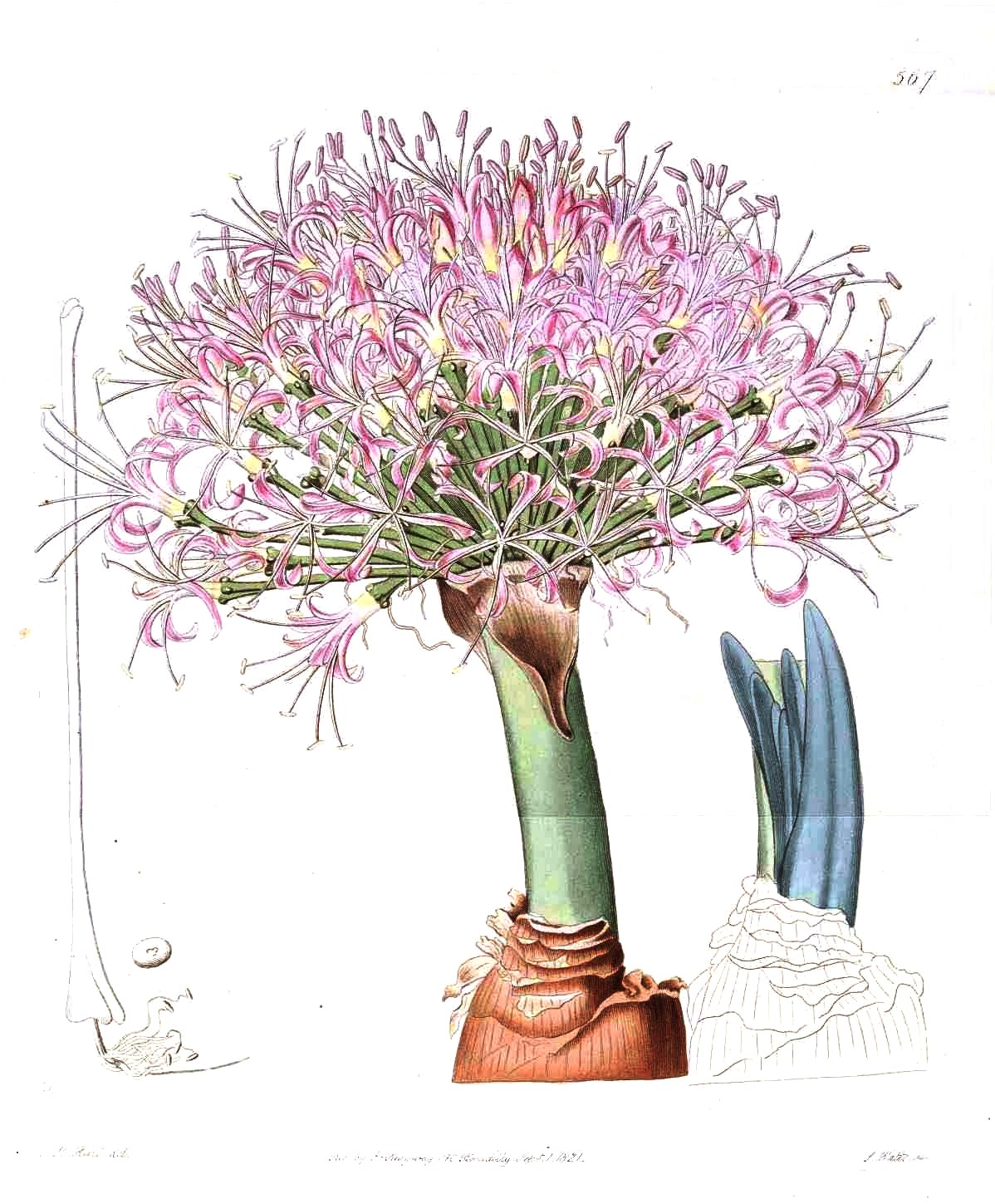
© Grabado de J. Watts sobre pintura de M. Hart, Botanical Register vol. 7, tab. 567 (1821). Dominio público.
Public domain
Overview
| Category | Classification |
|---|---|
| Family | Amaryllidaceae |
| Genus | Brunsvigia |
| Growth Habit | Medium-sized bulbous herb, summer geophyte; distichous leaves (in two rows) are a key diagnostic character, prostrate on the ground. |
| Conservation Status | Taxonomic status under review; under treatment as Boophone disticha: Least Concern (LC). As Brunsvigia toxicaria sensu stricto: Data Deficient (DD) for precise assessment. |
| pH Target | 6.5–8.0 |
| Type | Calcareous sand or well-drained sandy clay. |
Origin & Habitat
Requirements
Soil & Substrate
Type
Calcareous sand or well-drained sandy clay.
groups Beneficial Associations
chevron_right edit_note Proposed edits auto-approved at +3 net votes
No pending proposals for this section.
Propagation Strategy
8
T
Every 8–12 years; this species deeply resents repotting and may take several years to recover and rebloom.
Very dilute mineral feed (1/4 dose, NPK 3-1-5) once at the start of active autumnal growth; no fertilisation during dry months.
Uses & Applications
Precautions / Toxicity
HIGHLY TOXIC — Among the most dangerous of Amaryllidaceae. The bulb contains exceptionally high concentrations of lycorine, distychine, haemanthamine, narciclasine and bufotenine (in some sources). Narciclasine has confirmed cytotoxic activity and lycorine can cause respiratory paralysis at high doses. The San (Bushmen) historically used bulb extracts as arrow poison. EXTREME DANGER: keep completely out of reach of children, pets and livestock.
chevron_right edit_note Proposed edits auto-approved at +3 net votes
No pending proposals for this section.
Plant Health
chevron_right edit_note Proposed edits auto-approved at +3 net votes
No pending proposals for this section.
"The synonymy with Boophone disticha remains under active debate: distichous leaves and solid scape are characters shared with Boophone, but Ker Gawler's treatment as Brunsvigia toxicaria retains historical and practical value in herbaria. Check Plants of the World Online (POWO) for updated nomenclatural status before any scientific publication."
chevron_right edit_note Proposed edits auto-approved at +3 net votes
No pending proposals for this section.
Scientific Integrity
🔴 LowVote to help validate this record
Sources
Loading…
Discussion
Disclaimer
This species record is provided for educational and informational purposes only. Jardín Roca Negra does not guarantee the accuracy or completeness of the data. Content is community-curated and may be subject to revision; it should not replace advice from a qualified botanist. This species may be toxic, invasive, or subject to legal restrictions — verify before handling or cultivating. Jardín Roca Negra accepts no liability for any harm arising from reliance on this information. Images are reproduced under Creative Commons or equivalent free licenses; credits are noted below each image.