
Ammocharis coranica (Ker Gawl.) Herb.
Karoo lily / Ground lily
Ammocharis coranica is the most widespread and well-known species in the genus, with a range spanning from South Africa's Eastern Cape to Uganda. It produces prostrate strap-like leaves and umbels of 15–30 tubular pink to pale lilac, fragrant flowers emerging on a robust scape in autumn-winter. It is widely used in ethnomedicine throughout its distribution range, and its alkaloids have been extensively studied. It adapts well to cultivation in Mediterranean gardens and dry-winter climates.
chevron_right edit_note Proposed edits auto-approved at +3 net votes
No pending proposals for this section.
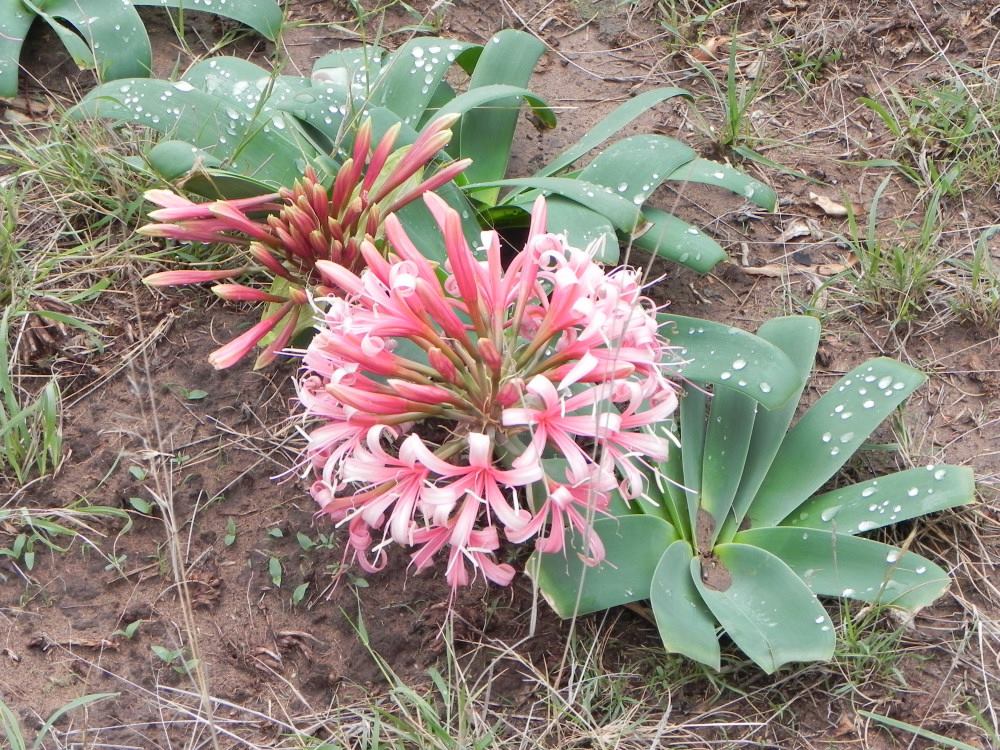
© Kate Webster00, CC BY-SA 4.0, via Wikimedia Commons
CC BY-SA 4.0
Overview
| Category | Classification |
|---|---|
| Family | Amaryllidaceae |
| Genus | Ammocharis |
| Growth Habit | Acaulescent geophyte; prostrate strap-shaped deciduous leaves; large tunicated bulb (10–18 cm in diameter). |
| Conservation Status | Least Concern (IUCN). Very widespread species in eastern and southern Africa; locally abundant in savannas and seasonal grasslands. |
| pH Target | 6.0 – 7.5 |
| Type | Sandy-clay or sandy loam, well drained; tolerant of poor and calcareous soils. |
Origin & Habitat
Morphology
Strap-shaped leaves 30–60 cm long, radially prostrate from the bulb, bright green. They develop after flowering in winter-spring and wither in summer.
ecoCompact umbels of 15–30 tubular flowers in pink, pale lilac or pinkish-white, with 6 reflexed tepals and exserted stamens. Very fragrant, with a sweet scent especially at night. Scape 15–30 cm.
ecoTunicated globose bulb 10–18 cm in diameter, partially emergent from the soil. Outer fibrous tunics cream to brown. Very long-lived — can exceed 30 years.
ecoWhite fleshy contractile roots, regenerating annually at the start of the vegetative period. They gradually deepen the bulb in sandy soils.
ecochevron_right edit_note Proposed edits auto-approved at +3 net votes
No pending proposals for this section.
Requirements
Soil & Substrate
Type
Sandy-clay or sandy loam, well drained; tolerant of poor and calcareous soils.
groups Beneficial Associations
chevron_right edit_note Proposed edits auto-approved at +3 net votes
No pending proposals for this section.
Propagation Strategy
- 1 Collect recalcitrant seeds (non-storable) as soon as the capsule opens.
- 2 Sow immediately in moist sandy substrate at 1 cm depth.
- 3 Maintain at 22–28 °C and moderate humidity; germination in 2–3 weeks.
- 4 First leaf emerged: begin summer-dry watering cycle.
- 5 Transplant after one year when bulblet is at least 2–3 cm in diameter.
- 1 Extract the mother bulb at the end of dormancy, before leaves appear.
- 2 Carefully separate lateral bulblets; allow to heal for 48 h.
- 3 Plant in sandy substrate with neck at soil level.
- 4 First watering after 7 days; then follow normal winter-dry cycle.
O
Watering in summer during dormancy: causes fatal rot.
Every 3–5 years at the end of summer. Keep in a shallow wide pot; tolerates being pot-bound well.
One application of low-nitrogen fertiliser (5-10-10 formula or similar) in early autumn when floral scapes emerge. No fertilisation during the dormancy period.
Uses & Applications
Precautions / Toxicity
Toxic. Contains lycorine, narciclasine, haemanthamine and other Amaryllidaceae alkaloids. Dangerous to humans, dogs, cats and herbivores. Ingestion causes vomiting, hypotension, convulsions and can be fatal at high doses.
chevron_right edit_note Proposed edits auto-approved at +3 net votes
No pending proposals for this section.
Plant Health
chevron_right edit_note Proposed edits auto-approved at +3 net votes
No pending proposals for this section.
"A. coranica is the species in the genus with the greatest phytochemical coverage: its alkaloids — especially narciclasine and lycorine — have shown significant cytotoxic activity against human tumour lines (MCF-7, HeLa) in multiple studies. It also has acetylcholinesterase inhibitory activity (relevant for Alzheimer research). In its native range it is used by Zulu and Nguni healers to treat skin infections and inflammation."
chevron_right edit_note Proposed edits auto-approved at +3 net votes
No pending proposals for this section.
Scientific Integrity
🔴 LowVote to help validate this record
Sources
Loading…
Discussion
Disclaimer
This species record is provided for educational and informational purposes only. Jardín Roca Negra does not guarantee the accuracy or completeness of the data. Content is community-curated and may be subject to revision; it should not replace advice from a qualified botanist. This species may be toxic, invasive, or subject to legal restrictions — verify before handling or cultivating. Jardín Roca Negra accepts no liability for any harm arising from reliance on this information. Images are reproduced under Creative Commons or equivalent free licenses; credits are noted below each image.