
Adenium somalense
Somali desert rose
Adenium somalense is a caudiciform succulent in the family Apocynaceae, native to the arid territories of the Horn of Africa — primarily Somalia, northeastern Kenya, and eastern Ethiopia. It thrives in conditions of extreme aridity on rocky calcareous soils, where it develops a highly branched, tall, and slender caudex with a more tree-like stature than other species in the genus. Its flowers, smaller than those of A. obesum, are pink with a darker throat. The species is slow-growing and reaches heights of up to 3 meters in its natural habitat. In botanical collections it is prized for its slender architectural form and exceptional drought tolerance.
chevron_right edit_note Proposed edits auto-approved at +3 net votes
No pending proposals for this section.
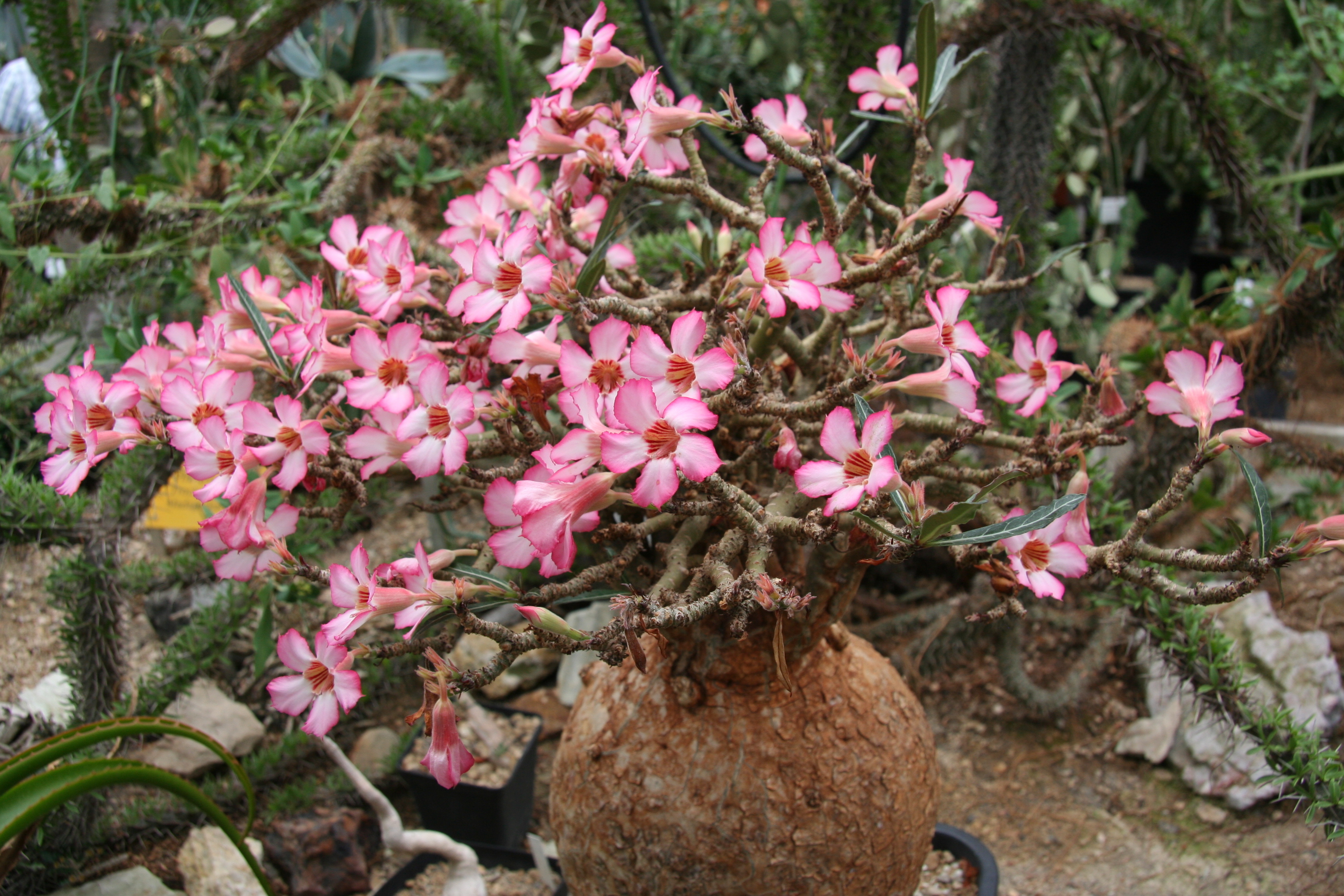
© Frank Vincentz
CC BY-SA 3.0
Overview
| Category | Classification |
|---|---|
| Family | Apocynaceae |
| Genus | Adenium |
| Growth Habit | Tree-like to tall shrubby caudiciform succulent; slender, branched caudex at the base with an open crown and ascending branches |
| Conservation Status | Data Deficient (DD) — IUCN; political instability in Somalia hampers population studies; potentially vulnerable due to deforestation and collection |
| pH Target | 6.5–7.5 |
| Type | Rocky calcareous soil with rapid drainage; mineral substrate with neutral to slightly alkaline pH |
Origin & Habitat
Morphology
Caudex relatively slimmer and more elongated than in A. obesum, gray-green in color with a smooth texture. Branches are more numerous and divide from a narrow base. In the wild the main trunk can reach 20–40 cm in diameter, much less than A. obesum. Young stems are green, turning gray with maturity.
ecoLanceolate to linear-lanceolate leaves, narrower and longer than those of other species in the genus: 8–15 cm long by 1–3 cm wide. Dark, shiny green above. Slightly leathery texture. Clustered at branch tips. Deciduous during periods of extreme drought.
ecoFlowers smaller than those of A. obesum, 3–5 cm in diameter, funnel-shaped, pale to medium pink with a darker throat (carmine or deep pink). Petals are narrower and have a slightly satin texture. Flowering occurs mainly in spring and sporadically after rains.
ecoDeep and extensive root system adapted to rocky, arid soils. Main roots descend vertically in search of deep moisture. The base of the caudex widens slightly above ground, forming a lateral support structure.
ecochevron_right edit_note Proposed edits auto-approved at +3 net votes
No pending proposals for this section.
Requirements
Soil & Substrate
Type
Rocky calcareous soil with rapid drainage; mineral substrate with neutral to slightly alkaline pH
groups Beneficial Associations
chevron_right edit_note Proposed edits auto-approved at +3 net votes
No pending proposals for this section.
Propagation Strategy
- 1 Take cuttings in the warmest season (summer or early autumn).
- 2 Select young, semi-woody branches 8–12 cm long; wear gloves to protect against the sap.
- 3 Let the cut dry for 10–14 days (longer than A. obesum due to greater moisture sensitivity).
- 4 Plant in pure perlite or mineral mix in a small, well-drained container.
- 5 Maintain minimum temperature of 28 °C with basal heating if possible.
- 6 Avoid watering until signs of rooting appear (new leaves or resistance when gently pulled).
- 1 Collect fresh seeds from pods before they open spontaneously.
- 2 Soak in hot water (35–40 °C) for 8–12 hours.
- 3 Sow in quartz sand + perlite substrate (60:40) at 1 cm depth.
- 4 Maintain temperature of 32–36 °C with high humidity until germination.
- 5 Seeds germinate in 7–21 days; gradually reduce humidity.
- 6 Seedlings are sensitive to excess moisture: irrigate with a fine mister every 3–4 days.
Provide the maximum possible hours of direct sunlight; A. somalense is the most light-demanding species in the genus and the least forgiving of shade.
Watering at the same frequency as A. obesum: A. somalense needs even more spaced watering.
Every 3–5 years; the species grows slowly and does not require frequent repotting
Minimal fertilization: a single application of balanced fertilizer diluted to 1/4 strength in spring. Excess nutrients favor leaf growth at the expense of caudex thickening.
Uses & Applications
Precautions / Toxicity
IMPORTANT: Adenium somalense contains cardiac glycosides (cardenolides) highly toxic to humans and animals in all its parts. The white milky sap that exudes when any part of the plant is cut is especially dangerous. Handle with gloves; avoid contact with eyes and mucous membranes. Toxicity is comparable to that of A. obesum.
chevron_right edit_note Proposed edits auto-approved at +3 net votes
No pending proposals for this section.
Plant Health
Root rot from overwatering (Fusarium oxysporum, Pythium spp.): especially sensitive due to its adaptations to extreme drought. Symptoms include yellowing and leaf drop, followed by softening at the stem base. Treatment: stop watering, remove from substrate, cut away affected roots, treat with systemic fungicide (metalaxyl-m + mancozeb), and let dry for 14 days.
Adenium bud mite (Tegolophus adenium): microscopic mite that deforms young leaf buds, causing wrinkled, thickened, and distorted leaves. Treatment: prune affected parts and apply systemic acaricide (abamectin).
chevron_right edit_note Proposed edits auto-approved at +3 net votes
No pending proposals for this section.
"A. somalense is considered by some taxonomists as an umbrella species encompassing various local forms and varieties from northeastern Africa. The variety 'crispum', which has wavy leaves and larger flowers, is especially valued in horticulture. Political instability in Somalia has prevented systematic field studies, so the exact distribution and conservation status of wild populations remains poorly known."
chevron_right edit_note Proposed edits auto-approved at +3 net votes
No pending proposals for this section.
Scientific Integrity
🟡 MediumVote to help validate this record
Sources
Loading…
Discussion
Disclaimer
This species record is provided for educational and informational purposes only. Jardín Roca Negra does not guarantee the accuracy or completeness of the data. Content is community-curated and may be subject to revision; it should not replace advice from a qualified botanist. This species may be toxic, invasive, or subject to legal restrictions — verify before handling or cultivating. Jardín Roca Negra accepts no liability for any harm arising from reliance on this information. Images are reproduced under Creative Commons or equivalent free licenses; credits are noted below each image.