
Adansonia grandidieri
Grandidier's baobab
Adansonia grandidieri is the largest and most spectacular baobab in Madagascar, endemic to the arid zones of the west and southwest of the island. Its perfectly cylindrical trunks, with reddish hues and smooth surfaces, can reach 25–30 m in height, standing dramatically over the spiny savanna. The famous 'Avenue of the Baobabs' near Morondava, declared a Protected Natural Monument in 2007, is one of the most photographed landscapes in the world. It is an endangered species, primarily threatened by deforestation for maize cultivation and the loss of its pollinators.
chevron_right edit_note Proposed edits auto-approved at +3 net votes
No pending proposals for this section.
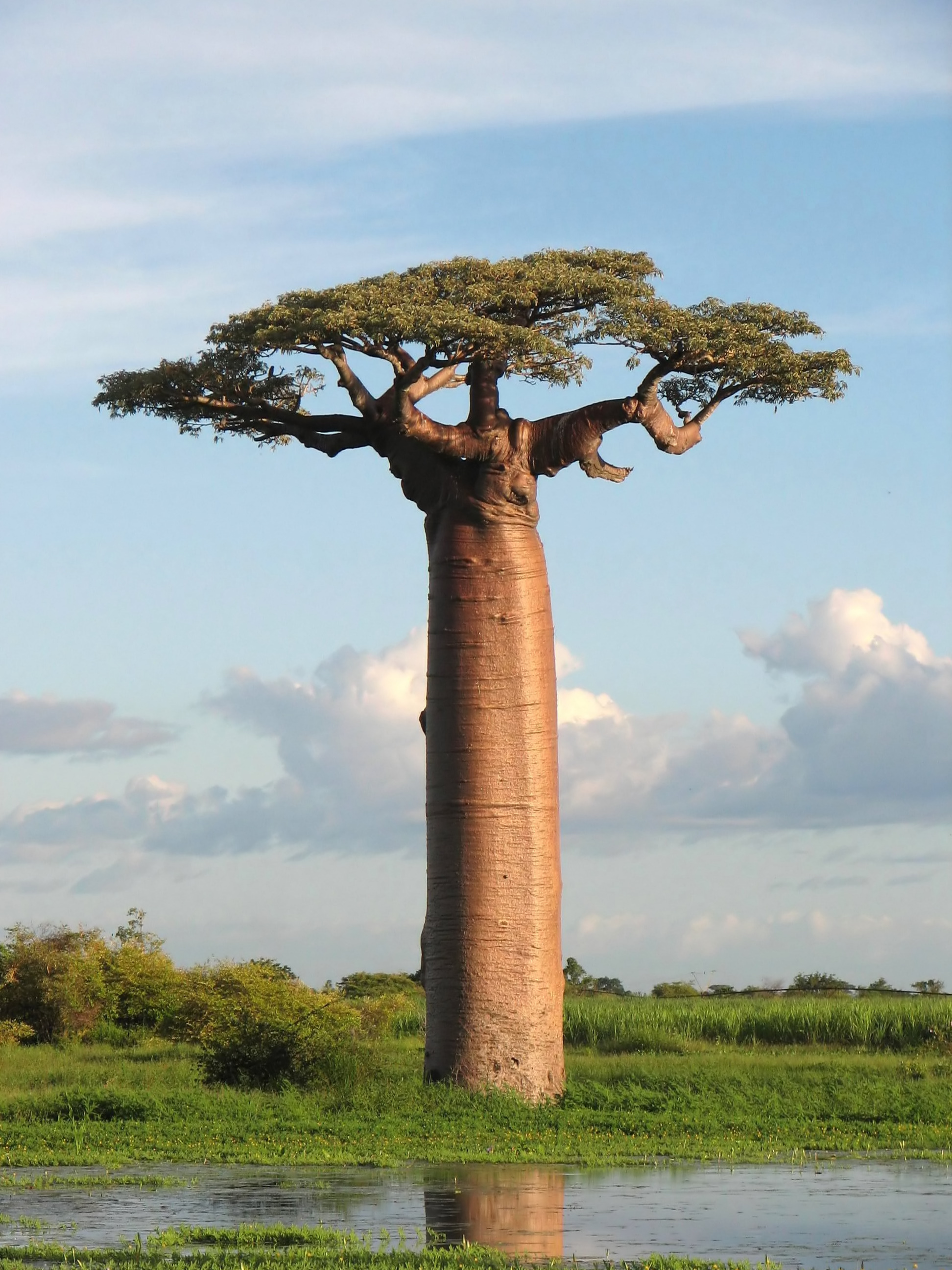
© Bernard Gagnon
CC BY-SA 3.0
Overview
| Category | Classification |
|---|---|
| Family | Malvaceae |
| Genus | Adansonia |
| Growth Habit | Tall deciduous tree with a very tall and cylindrical bole, with a reduced and flattened crown at maturity. Slow growth. |
| Conservation Status | Endangered (EN) according to the IUCN. The population continues to decline due to habitat destruction and lack of natural seedling regeneration. |
| pH Target | 6.0–7.0 |
| Type | Red lateritic soil, sandy to sandy-loam, excellent drainage, nutrient-poor. |
Origin & Habitat
Morphology
Extraordinarily cylindrical and straight, reddish or orange-brown in color with gray bands. Bark is smooth in young specimens and slightly fissured in adults. Trunk diameter can exceed 3 m, but is proportionally narrower than in A. digitata. This is the most striking diagnostic feature of the species.
ecoDigitate leaves with 6–8 elliptic to lanceolate leaflets, medium green in color. They appear only during the brief wet season (December–February in their natural habitat). Leaflets are narrower and more elongated than in A. digitata.
ecoLarge flowers (up to 20 cm in diameter), white with yellowish hues at the base of the petals. They hang from long peduncles and open at dusk. Unlike other species in the genus, in Madagascar the primary pollinators are believed to be lemurs (Microcebus spp.) and some large moths.
ecoOvoid fruits 20–35 cm in length, the largest in the genus. The woody shell is hard and greenish-brown in color. The dry cream-colored pulp is edible and very nutritious. The seeds, embedded in red fiber, are used locally to extract high-quality cosmetic oil.
ecochevron_right edit_note Proposed edits auto-approved at +3 net votes
No pending proposals for this section.
Requirements
Soil & Substrate
Type
Red lateritic soil, sandy to sandy-loam, excellent drainage, nutrient-poor.
groups Beneficial Associations
chevron_right edit_note Proposed edits auto-approved at +3 net votes
No pending proposals for this section.
Propagation Strategy
- 1 Obtain fresh seeds (optimal viability within 12 months of harvest). Older seeds require more aggressive scarification.
- 2 Scarify with 60–80 grit sandpaper until the testa shows a clear area of 3–5 mm.
- 3 Soak in water at 40 °C for 24–48 hours. Use only seeds that sink.
- 4 Prepare 10 cm pots with a mix of 60% river sand + 30% perlite + 10% cactus substrate.
- 5 Bury the seed 1 cm deep and keep at 30–35 °C with light watering every 3–4 days.
- 6 Germination in 2–6 weeks. The hypocotyl is very fragile; avoid moving the pot until the base trunk is visible.
To achieve the iconic thick cylindrical trunk, plant in the ground during the warmest available summers and maintain generous watering only during that period.
Not scarifying seeds: germination rate without this step is less than 5%.
Every 4–6 years. Move at the start of the wet season when buds begin to swell. Handle roots with extreme care.
Fertilize monthly with a low-nitrogen fertilizer (cactus type 2-7-7) during the growing season. Avoid nitrogen-rich fertilizers that produce succulent, rot-prone growth.
Uses & Applications
Precautions / Toxicity
No known toxicity. The pulp, seed oil, and young leaves are consumed by humans and local wildlife without documented adverse effects.
chevron_right edit_note Proposed edits auto-approved at +3 net votes
No pending proposals for this section.
Plant Health
Trunk base rot caused by soil fungi (Fusarium oxysporum, Pythium spp.): favored by waterlogging or excessive winter watering. The trunk softens and collapses from the base. Preventive treatment: perfect drainage and seasonal watering; curative treatment is very limited once infection is advanced.
Soft brown scale (Coccus hesperidum): forms colonies under bark and at branch junctions. Causes general weakening and sooty mold. Treatment: apply paraffinic oil in winter and systemic neonicotinoids in spring.
Trunk sunburn: young specimens can suffer bark burn if abruptly exposed to intense sun after a period of semi-shade. Prevention: progressive acclimatization to direct sun exposure.
chevron_right edit_note Proposed edits auto-approved at +3 net votes
No pending proposals for this section.
"The lack of natural regeneration of A. grandidieri is alarming: most individuals are adult trees with no young seedlings established around them, possibly due to the loss of large seed-dispersing lemurs. Conservation efforts include ex situ germination programs and active revegetation. In botanical collections, this baobab is prized for its perfectly cylindrical trunk and monumental stature."
chevron_right edit_note Proposed edits auto-approved at +3 net votes
No pending proposals for this section.
Scientific Integrity
🟡 MediumVote to help validate this record
Sources
Loading…
Discussion
Disclaimer
This species record is provided for educational and informational purposes only. Jardín Roca Negra does not guarantee the accuracy or completeness of the data. Content is community-curated and may be subject to revision; it should not replace advice from a qualified botanist. This species may be toxic, invasive, or subject to legal restrictions — verify before handling or cultivating. Jardín Roca Negra accepts no liability for any harm arising from reliance on this information. Images are reproduced under Creative Commons or equivalent free licenses; credits are noted below each image.